NXR South Championships

After our state meet in Texas we had three weeks till the NXN South Region race. When you have a race that requires all of your physical and emotional energy I feel it’s important to be careful the following week. We kept our mileage consistent, but dialed down the intensity. The one workout we had was a 3-2-1 fartlek on the grass for 30 minutes. We usually are more structured in our workouts, but I felt it was important to let our athletes go more by feel. The three and two minute repetitions around tempo pace and the 1 minute repetitions close to 5k race pace. In between the repetitions a 1 minute easy jog to allow adequate recovery. In addition to the one fartlek workout we also had a medium long run on a hilly route in Flower Mound.

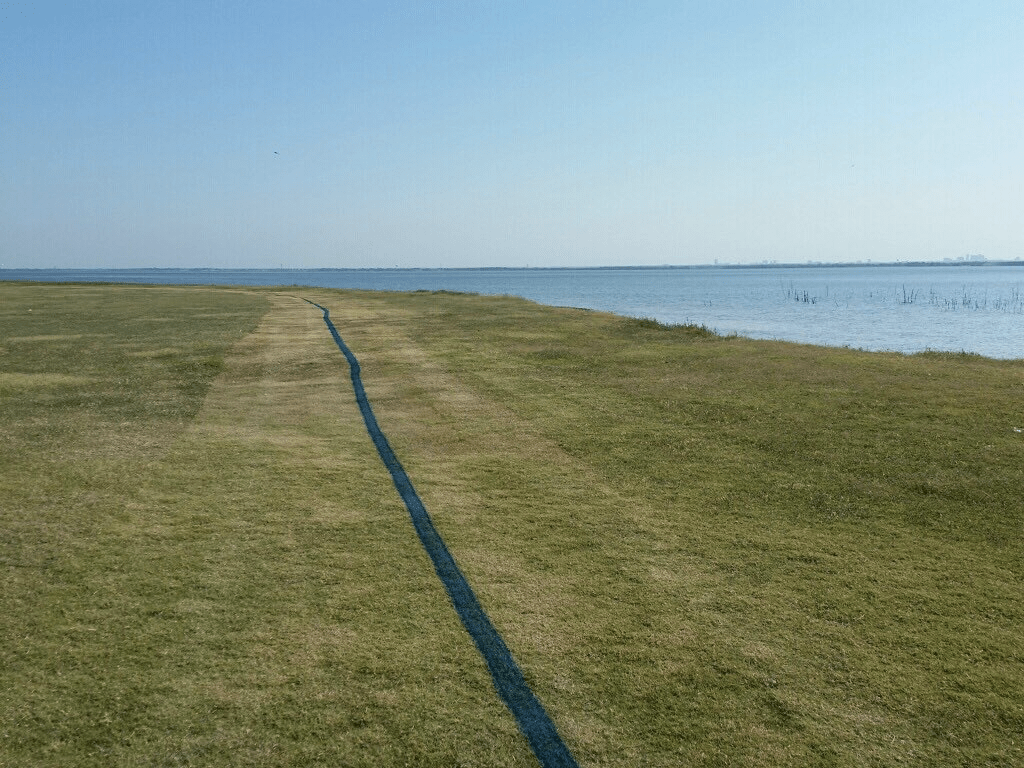
Westchester Park in Flower Mound. Only grass park we have within couple miles of Flower Mound High School

The next two weeks we returned to our usual cruise intervals on grass at our local park. We do something similar to what is listed below throughout the season.

Girls

Workout A: 1 mile warm up, 400 meters fast, 6-7xkm @ tempo pace, 400 meters fast, 1 mile cool down

Workout B: 1 mile warm up, 600 meters fast, 5-6×1200, 200 meters fast, 1 mile cool down

Boys

Workout A: 2 mile warm up, 600 meters fast, 8-10xkm @ tempo pace, 400 meters fast, 2 mile cool down

Workout B: 2 mile warm up, 600 meters fast, 7-8×1200, 400 meters fast, 2 mile cool down

We also had two track workouts that we focused on running at our a little faster than 5k pace

Girls and Boys Track Workout leading up to NXN South

Workout on the track: warm up, 2 (2×400, 1600), cool down. Recovery was 200 meter jog between 400’s and 3 minute standing rest after the 400’s and 3 minute rest after the 1600’s.

Our top girl athlete ran the workout in 5:26, 69, 71, 5:14, 70, 69.

One of our girl pack runners (6-10 on team) ran the workout in 5:56, 76,81, 5:59, 80, 78

NXN South Region at Texas A&M University

The NXN South Region race had previously been held at Bear Branch Park in The Woodlands. The course was known for being narrow and when it rained very muddy. We had mixed results at Bear Branch Park and some years when it was muddy it felt like whoever could sprint the fastest the first 600 meters had a good chance of going to NXN.

As participation continued to grow, the event required a new venue to accommodate runners and spectators. The Texas A&M course meets the requirements to not only host a large high school invitational meet, but also NCAA Championship races. The starting line is almost 100 meter wide to comfortably handle 30 teams and individual athletes. The course begins with an 800 meter wide straight that allows athletes to safely merge before the first turn. The rest of the course remains wide, includes rolling hills, and finishes with an 800 meter straightaway. I think this course is a big improvement over Bear Branch and I like that high school kids have the opportunity to race on a collegiate level course.

Middle mile at Dale Watts Texas A&M Cross Country Course


Flower Mound Girls NXR South Race

Going into this race I tried to make sure we stayed sharp and fresh after a long cross country season. Our girls were disappointed by a second place finish at state and we tried to use that as motivation going into the NXR South Race. I felt if we could hammer up front and run as a team we would have a good chance of qualifying again this year.

The start of the race was moved to 7 AM to avoid thunderstorms that were predicted to roll into College Station by noon. We have had early starts to beat the heat before, but 7AM in November felt very early. I looked at the weather app on my phone and it said the sun wouldn’t even rise till 7:10 AM. The race was recorded on milesplit and it’s hard to even pick out the runners the first couple miles because it was still dark.

The race did start exactly at 7AM and I stood close to the kilometer mark awaiting our team. We looked like we had a good start, but it was tough to tell with many of the teams wearing different club uniforms. When the score populated for the first mile we were in third place with 121 points. From looking at the other regions and national rankings I thought we would have to place in the top two to earn at spot to NXN. I wasn’t ready to panic at this point and felt there was still plenty of time to move up, especially with the rolling hills in the second and third miles.

Split scores for NXR South
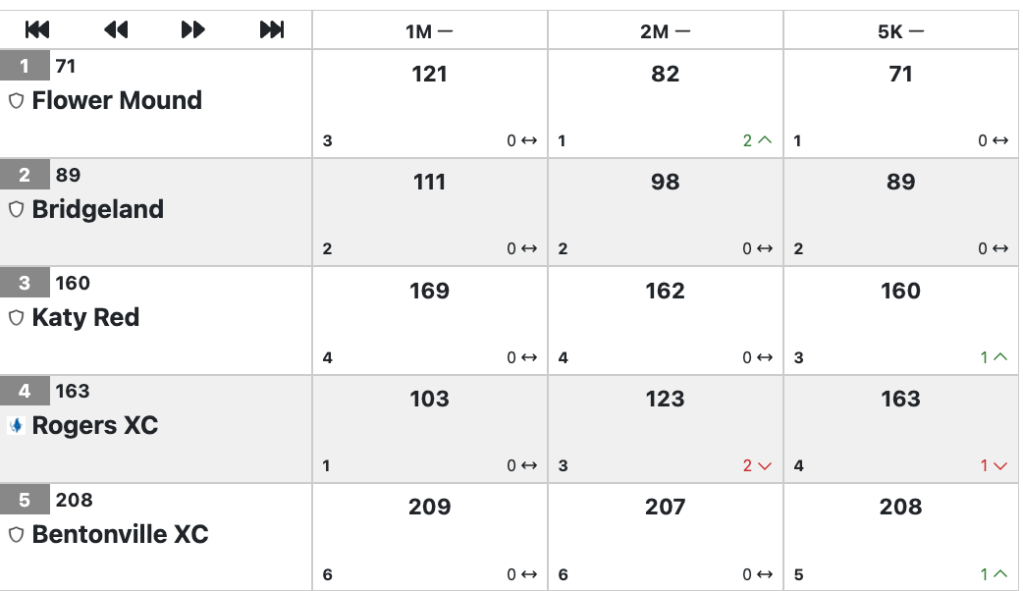
We ran great in the second mile with our front three runners all in the top 20 for team scoring. Our fourth runner moved from 36th to 28th place and our fifth runner moved from 57th to 33rd. We were now in first place and I felt like we had a great chance of advancing to NXN, but still wanted us to finish better than we had at state.

I ran to the finishing straight which is almost 800 meters long to cheer on our runners. It’s pretty brutal to see the finish banner and still know you have 2-3 minutes of the race remaining. Our girls looked to be holding their positions or passing other runners. When the scores originally populated it showed that we finished second. I was disappointed to see that we had come up short again after leading at the two mile mark. When I looked closer at the results I noticed that our number one runner was missing. I sprinted to finish line and was worried that she was hurt or maybe had passed out from the effort and was unable to finish. When I got to the finish line she informed me that she did more than just finish and had passed a couple runners to finish in eight overall and first in the team scoring.

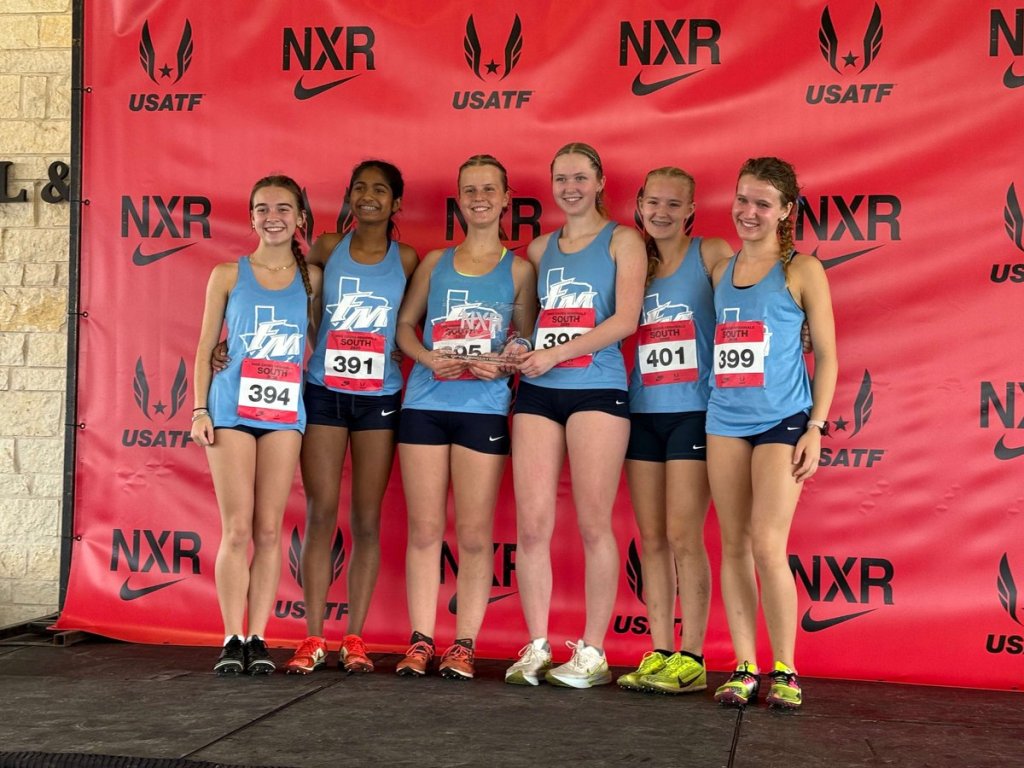
Fortunately the results were fixed quickly and when they added our number one runner in the results we had won with 71 points. A very low score for a meet with 33 teams and great competition.

NXR South Winners

I also want to add I’m very proud of the way our JV girls competed in the open race to place first. They worked hard all year and put in a great performance after not racing since mid October.

NXR Open Championship Winners
I’m on a roll with two posts in one week! I’ll try my best to get another post in soon on the Nike Cross Nationals experience.

One-Time
Monthly
Yearly

Make a one-time donation

Make a monthly donation

Make a yearly donation

Choose an amount

$5.00
$10.00
$20.00
$5.00
$15.00
$100.00
$5.00
$15.00
$100.00

Or enter a custom amount

$

Your contribution is appreciated.

Your contribution is appreciated.

Your contribution is appreciated.

DonateDonate monthlyDonate yearly

Choosing Spin Bikes and Ellipticals for Your Cross Country Team

About 15 years ago, we started purchasing spin bikes and ellipticals for our cross country team. Initially, we bought three spin bikes primarily for injured athletes who needed a low-impact training option. It wasn’t until a few years later that we began using cross training as a way to add more aerobic volume to our overall program.

In the beginning, I struggled to find the right equipment something that was affordable, durable, and challenging enough for our athletes. After a lot of trial and error, here’s what I’ve learned about what to look for when buying spin bikes and ellipticals.

FMHS BIKE ROOM


What to Look for in a Spin Bike

There’s a wide range of spin bikes available on Amazon and elsewhere, so it’s important to know what features matter most. Here’s what I typically look for when purchasing a spin bike:

  • Adjustable seat and handlebars: Make sure the bike can accommodate both shorter and taller athletes. Proper fit is key for comfort and safety.
  • Flywheel weight of at least 40 lbs: A heavier flywheel usually means better durability and a smoother ride.
  • Chain-driven system: While many people prefer belt-driven bikes for their quiet operation, I’ve found that chain-driven bikes feel more like riding a real bicycle.
  • Comfortable seat: Since our runners don’t wear padded cycling shorts, the bike seat should have some built-in cushioning.
  • Caged pedals: These allow athletes to stand and pedal out of the saddle safely and easily.

Things I don’t consider essential: a fancy display or a mount for an iPad or phone. Most of our athletes aren’t focused on data like watts or cadence. Instead, we emphasize effort and heart rate.

The spin bike we’ve most recently purchased is from Sunny Health & Fitness for around $249. You can find solid, durable spin bikes for under $300, which is great for team budgets.

👉 Spin Bike on Amazon


What to Look for in an Elliptical

Ellipticals are a tougher purchase. You have to be careful not to buy the cheaper models they often won’t last more than a year, especially with every day team use. Assembly is also critical; even one loose screw can cause squeaking or instability.

Here’s what I recommend looking for:

  • 20-inch stride length: This stride length feels the most natural for runners and fits a wide range of athletes. It also provides a better workout because of the increased range of motion.
  • Variety of resistance and incline options: While I typically have athletes keep the incline low, having multiple settings helps adjust workout intensity and target heart rate. Be careful with some ellipticals that may be too d
  • Ease of use: The best ellipticals power on as soon as you start pedaling and have simple, intuitive displays. You shouldn’t have to explain how to use it before every workout. We have close to 100 athletes on our team and I don’t have time to teach every one of them how to use the elliptical.

Some good ellipticals that we have used in the past or currently

ProForm Elliptical

Schwinn 430 Elliptical


Final Thoughts

In closing good luck to everyone with the rest of your cross country season. Sorry I haven’t posted as much in the past few months. If you have any questions concerning cross training equipment or cross training in general you can respond to this post or shoot me an email. Also if you would like to learn more about how we use cross training in our program a presentation is available below.

Cross Training for Distance Runners

2024 UIL State Cross Country Meet

Below are my thoughts on the state meet and our season

Why is state so early?

After speaking with many coaches, most expressed satisfaction with the state meet course and UIL management, with no significant issues reported. However, one concern stood out—the date of the state meet. Over time, the state meet has gradually been scheduled earlier and earlier. This year, it was held on November 1st, and next year it looks like the race will fall on Halloween (scary!).

In 2025, district certification is set for October 11th. With most teams taking the week off before district, this means all regular-season meets will need to be completed in August and September. To fit in the eight regular-season meets allowed by the UIL, the first meet would have to be scheduled as early as August 9th. This would result in four meets in August and four in September.

As most coaches and athletes know, racing in August can be both challenging and potentially dangerous, particularly for athletes who are new to the sport. To address these concerns, more teams have begun hosting shorter races, such as 2 mile runs or relay events like the 4×1.5 miles, to reduce the risk of heat related issues. While it’s great that schools are prioritizing the safety of their athletes, it’s unfortunate that these adjustments are necessary due to the increasingly early scheduling of district certification and the state meet.

State Meet Course

The start remains one of the strengths of the course, with around 600 meters before the first turn in the race. I’d like the starting line to be slightly wider, as I believe there’s enough space to add another 30 yards of width. This expansion would allow each team to comfortably fit all seven athletes on the line.

Due to construction at the park (not the UIL’s fault), there was a narrowing of the course, primarily in the second mile. This made passing difficult and favored teams or individuals who took advantage of the fast first mile.

The increase in fencing along the course has improved athlete safety. In past years, crowd control had become a concern, with the risk of a spectator interfering with runners.

Was the course long, and does it even matter?

I didn’t measure the course myself, but I did check GPS data from our athletes who ran it the day before. Most recorded around 3.15 to 3.20 miles on their GPS watches. Although GPS isn’t perfectly accurate, I believe the course was close to 3.1 miles. Since this was the state meet, most athletes seemed focused on competing rather than fast times.


Flower Mound Jaguars

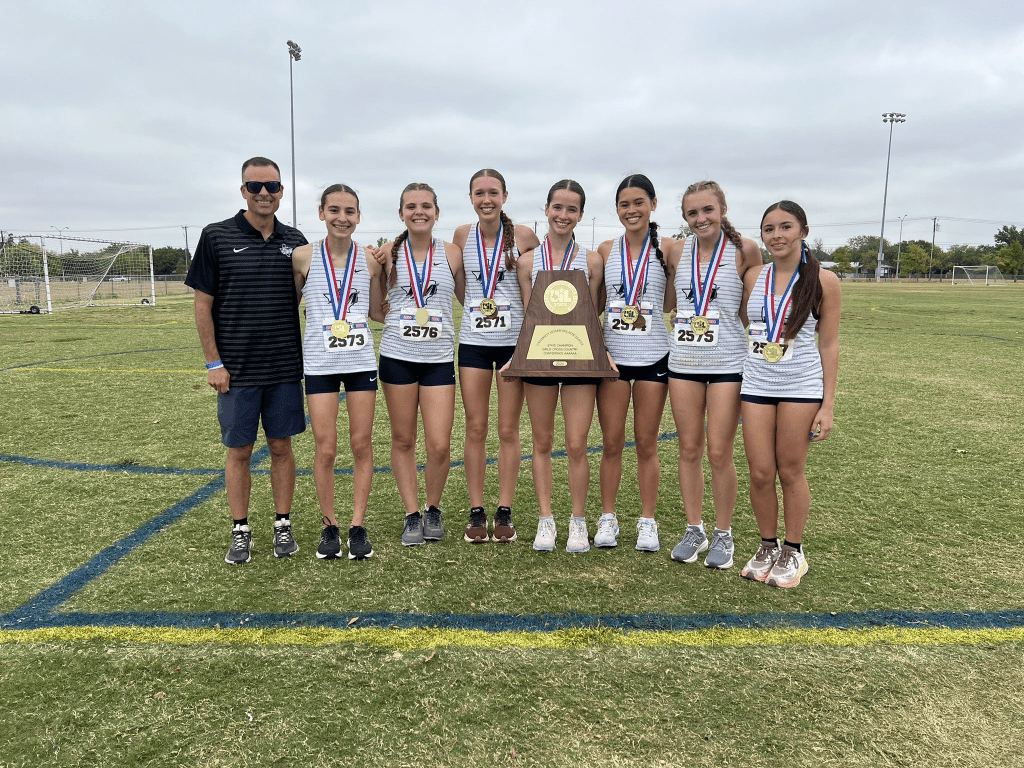
I don’t usually write specifically about our team, but I’m incredibly proud of our girls for winning their fifth consecutive state championship. With so many great teams and coaches in Texas, reaching the top of the podium is a huge achievement. I’m also proud of our boys for returning to state and placing eighth. Our boys didn’t have a standout individual, yet they worked hard as a cohesive team all season to achieve their goals.

Some Things We Did as a Team to Reach Our Goals

Taking a Break This Summer – For the first time in my coaching career, I took about three weeks off from coaching this summer. This break helped me feel fresher and more energized when we started serious training in August. By the end of last cross country season, I was mentally and physically burned out. While this wasn’t the athletes’ fault, I realized I wasn’t taking care of myself.

Keeping Things Simple – Our workouts primarily consisted of threshold repetitions, 200-meter hill repeats, and some form of fartleks. We rotated through these three for most of the season. This approach made it easier to monitor athletes’ progress and maintain consistency.

Focusing on the Team – We emphasized the importance of working hard together and pushing each other to improve.

Character Counts – We had great leaders on our team who understood our program’s expectations and led by example.

Track Matters – A strong track season often leads to a strong cross country season. Last year, we graduated two of Texas’s best distance runners on the girls’ side. This year, we could have settled for less, but our JV girls worked hard during track season and improved dramatically. Their progress on the track gave them the confidence to compete for another state championship.

What I look for in a cross country meet

I’m currently working on our cross country schedule for the 2023 season. It seems like I have been falling behind other coaches on getting this done! As I put together our schedule I usually think about the following things before committing to a meet.

2019 Flower Mound Invitational at Lake Park in Lewisville

  • Meet Management: When our team goes to a meet I hope it is well run. The meet starts on time, results are posted, course is accurate in distance, and there are enough bathrooms for the runners. Extra bonus if a meet has starting boxes!
  • Course Quality: Course is well maintained, wide starting line, well marked, wide enough course to allow passing and avoid bottlenecks. This is high school cross country and I don’t expect, nor do I want my team to run on a golf course. I do try and avoid courses that have too many rocks or holes. We are trying to build towards district not find a way to sprain an ankle.

Watch out for gopher holes at the Region 1-6A Championships in Lubbock

  • Meet Competition: Each year is different. With experienced teams I may look for a more challenging schedule. If we have a younger team we may try and find meets that will build our confidence. We are fortunate in North Texas to have both options available without having to travel out of town. For individual athletes who are looking to place high at state I think it’s important they face strong competition. We want them to be pushed and mentally prepared for what they will see in the postseason.
  • Number of Meets: I usually schedule 6-7 meets in a season. Our varsity athletes who have more experience may only run 4 meets before the start of district. I know the UIL allows us to have eight meets in a season, but that seems excessive and requires us to race every weekend starting in the middle of August. I think it’s great for JV and Varsity athletes to have a time during the season to focus only on training.
  • Timing of the Meet: We like to test ourselves at the beginning and end of the regular season. First meet I like to see how we are doing after our summer training. Towards the end of the season I want to see how we have progressed and make sure we are sharp and ready to go for district. This year our first 5km cross country meet is at the Telaneus Invitational. This meet is one of the biggest most competitive meets in the DFW area. Our last regular season meet is the Nike South Invitational. Each year we look forward to racing the best teams in Houston and who knows what teams will also make the trip to run at the Nike Regional Course in The Woodlands.
  • Proximity: Sometimes it’s just nice to hop on a bus and get there within 15-20 minutes. Families will usually travel and cheer on their child if the meet is closer.
  • Tradition: Many times I like to go to the same meet each year. For example the Telaneus Invitational is the same course and it gives us a great gauge/idea on our level of fitness. We can look at our finish times and examine our splits and finish times from previous years.
  • Coaches Hospitality: This isn’t the most important, but it’s nice! Some meets are long and it’s hot in Texas! Water, Gatorade can go a long way for coaches that are running around the course coaching their team.
  • Meet Start Time: I usually try and avoid meets that start at a later time in the morning. If we are going to a meet in August or September I don’t want my athletes running at race past 11 AM. It’s just too dang hot and it does not build confidence or give any indication of an athletes fitness. Meets typically have the JV runners compete last and for some of these kids it’s hard enough to run a 5k in good weather let alone with the temps climb into the 90s.
  • Try Something New: When creating our schedule I look at adding a new meet to our schedule. We can get in the habit of running the same meets against the same individuals and teams. Running a new course is fun and provides new challenges.
  • Different Distances: In the beginning of the year we like to run shorter distances or run a relay race. I think this is especially great for our freshmen athletes as we try and build their confidence up to race 5km. This year our first meet is the Southlake 3200 on the track. I know it’s weird to start at cross country season on the track, but it’s something all of our athletes can handle. For our returning athletes they can try and set a 3200 meter PR which is a good motivator.

The second meet on our schedule is the Greenhill Relays. The meet format is a 4×1.5 mile relay. Each athlete runs with a glove, which in this meet serves as a baton. I like running the relay because it gets the kids to focus more on the team aspect of cross country.

Nothing like watching distance runners hurdle hay bales @ Greenhill Relays

Coaching Freshman Runners

We just started our summer training with the team, and we have many new faces. I’m currently trying my best to learn all their names. Each year, my goal is to help freshmen have a smooth transition from middle school to high school, considering they had only one month dedicated to cross country in middle school compared to joining a team that trains year round. Here are some of the things we focus on to support our freshmen runners in our program.

Training

To ensure the safety and prevent any athletes from getting hurt or quitting due to intense training, we take a slow approach with new team members. Although I aim to push them, my primary goal is to have the freshmen ready to race three miles when the season begins. During the first week, we keep it simple by focusing on dynamic warm-up drills, running 1-2 miles, and cool-down stretches.

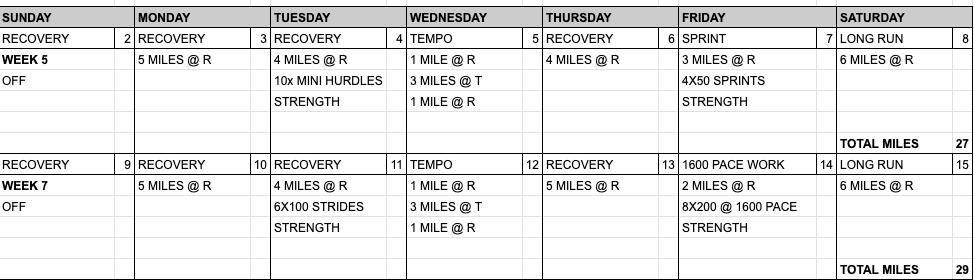
We have seven training groups throughout the summer, with the freshmen starting in group seven, which has the lowest weekly mileage. Below is an overview of our team’s first full week. I believe 10 miles for the first week is reasonable and understand if an athlete needs to take walking breaks.

Building Relationships

During the summer, I prioritize building relationships with our freshmen athletes. I make an effort to arrive at practice 15 minutes early to greet them by name (if I can remember!) as they enter. After their workouts, I ask them about their run and tell them good job before they leave. Although it may seem simple, I hope that by the end of the summer, we will know each other better and feel more comfortable communicating.

I also encourage our veteran athletes to welcome and learn the names of the freshmen. We discuss the experience of joining a new program and emphasize the importance of being friendly and welcoming to all athletes. Additionally, once a week, we have a team breakfast at one of the athletes’ houses. I intentionally do not attend these breakfasts, as it provides an opportunity for the team to bond and get to know each other without the coach present.

Learning about Running

Summer practices serve as an opportunity to educate the freshmen about the basics of running. Topics such as the significance of proper footwear and nutrition in the morning are discussed during our morning meetings or in a more casual manner after their workouts. For instance, we recently talked about the equation “STRESS + REST = GROWTH.” As the freshmen experience the stress of daily running, we emphasize the need for adequate sleep to facilitate recovery and growth as athletes.

We also address the importance of having appropriate running equipment. Often, we find boys wearing excessively long shorts or girls opting for thick, oversized cotton shirts. We discuss the benefits of wearing breathable lightweight materials, especially during the hot summer months. It’s worth noting that running clothes are available at various stores in our area, and they don’t need to be expensive brand items like Lululemon for our practices.

In addition to running attire, we encourage our athletes to replace their middle school gym shoes with 1-2 pairs of running shoes. If possible, we suggest having two pairs to rotate during the summer. This practice helps prevent overuse injuries and allows the shoes to air out for a couple of days.

Safety

One of the most important topics we stress over the summer is safety while running. We make sure they understand the importance of utilizing sidewalks whenever possible. In cases where sidewalks are unavailable, we instruct them to always run against oncoming traffic. Additionally, we emphasize the significance of waiting for vehicles to come to a complete stop before crossing streets or intersections. Lastly, we strongly encourage the practice of having a running buddy. As our groups can sometimes spread out, it is essential for athletes to have a teammate with them for added safety and support.

Freshmen athletes with running experience

One last thing. We are fortunate to have running clubs and summer track programs in our area. It’s not uncommon for us to get athletes in high school that have previous running experience. With these athletes we talk about their training experience and try to put them in the correct training group. Usually I err on the side of caution and have them run the same or less mileage than they did in middle school. I do this because our training is still most likely different and they will need time to adjust. I also feel that most middle school kids are like all other runners and occasionally overestimate their weekly mileage.

One-Time
Monthly
Yearly

Make a one-time donation

Make a monthly donation

Make a yearly donation

Choose an amount

¤5.00
¤10.00
¤20.00
¤5.00
¤15.00
¤100.00
¤5.00
¤15.00
¤100.00

Or enter a custom amount

¤

Your contribution is appreciated.

Your contribution is appreciated.

DonateDonate monthlyDonate yearly
Cross Country Summer Training

The track and field season has come to an end, and now it’s time to turn our attention to cross country. Summer training is when athletes put in those early morning miles to reach their team and individual goals. I have always enjoyed summer training and see it as an opportunity for our team to bond and reach new levels of fitness together.

Below are four types of runs that we focus on during the summer.

Long Run: 20% of an athletes weekly mileage. During the season the pace of the long run is faster, but during the summer we relax more and focus on getting the distance in for the day. With the heat I’m not going to push an athlete for an extended period of time.

Distance Runs: These runs make up the majority of our summer training. We maintain a pace around 2:30 minutes slower than an athlete’s mile PR. These are my favorite runs as they provide an excellent opportunity for team bonding, as we run at a conversational pace.

Mile Pace Work: Throughout the summer we have one workout a week that is focused on mile pace. Start with something as simple as 4×200 and build to 12-16×200 at mile pace towards the end of the summer. Gets athletes out of the plodding and helps when we transition to more serious work in the fall.

Progressive Runs: Again because it’s hot we try and focus on finishing one to two runs a week faster. For example a 5 minute miler would run 4 miles at 7:00 pace and then 2 miles @ 6:00 pace. Workout isn’t crazy hard and they feel good to have finished strong and fast.

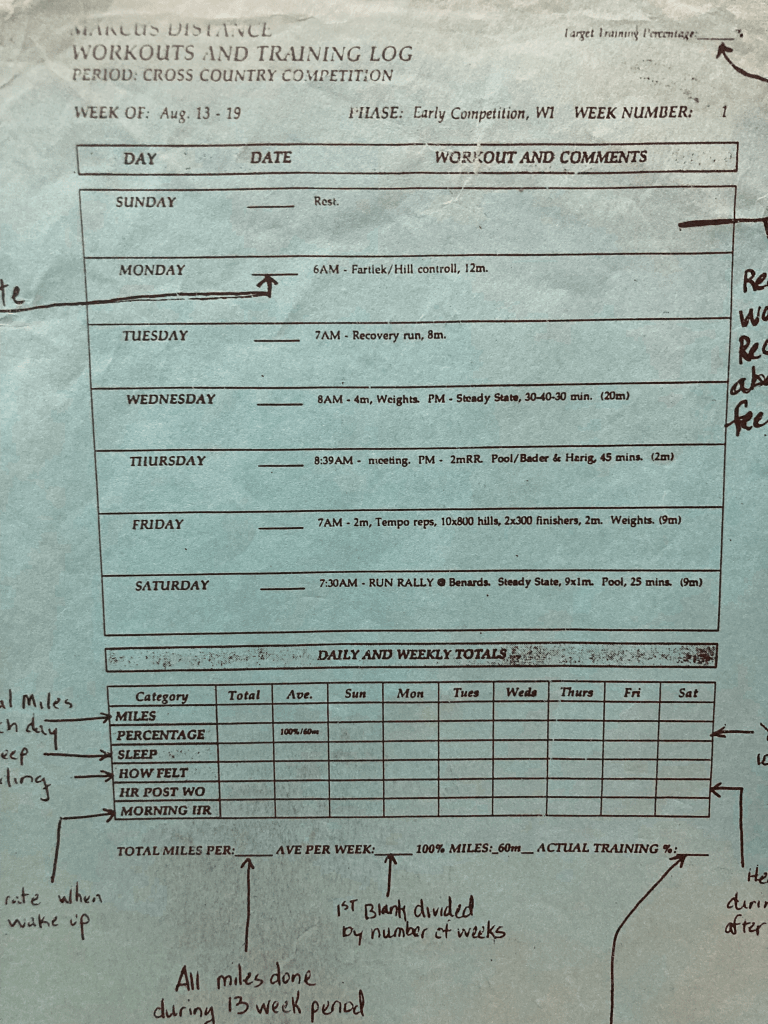
We track our summer training on a google document. I know many teams use training logs and record their mileage in a notebook. We did this as well when I was a runner at Marcus High School. Our coach Steve Telaneus did an amazing job of focusing on the details and it showed in our training logs.

Marcus Cross Country Training Log– 1997

Flower Mound Cross Country Training Log- 2023

While our training logs may have different formats, most of our training remains the same. Usual tempos/progressive runs, strides, hills, and of course recovery/distance runs. No matter the training I think the teams that are most successful in the fall are the teams that were the most consistent in the summer.

Good luck to all teams this fall and I hope everyone has a great summer!

Steve Telaneus: Developing a Successful Cross Country Program: The Complete Guide from A to Z