Choosing Spin Bikes and Ellipticals for Your Cross Country Team

About 15 years ago, we started purchasing spin bikes and ellipticals for our cross country team. Initially, we bought three spin bikes primarily for injured athletes who needed a low-impact training option. It wasn’t until a few years later that we began using cross training as a way to add more aerobic volume to our overall program.

In the beginning, I struggled to find the right equipment something that was affordable, durable, and challenging enough for our athletes. After a lot of trial and error, here’s what I’ve learned about what to look for when buying spin bikes and ellipticals.

FMHS BIKE ROOM


What to Look for in a Spin Bike

There’s a wide range of spin bikes available on Amazon and elsewhere, so it’s important to know what features matter most. Here’s what I typically look for when purchasing a spin bike:

  • Adjustable seat and handlebars: Make sure the bike can accommodate both shorter and taller athletes. Proper fit is key for comfort and safety.
  • Flywheel weight of at least 40 lbs: A heavier flywheel usually means better durability and a smoother ride.
  • Chain-driven system: While many people prefer belt-driven bikes for their quiet operation, I’ve found that chain-driven bikes feel more like riding a real bicycle.
  • Comfortable seat: Since our runners don’t wear padded cycling shorts, the bike seat should have some built-in cushioning.
  • Caged pedals: These allow athletes to stand and pedal out of the saddle safely and easily.

Things I don’t consider essential: a fancy display or a mount for an iPad or phone. Most of our athletes aren’t focused on data like watts or cadence. Instead, we emphasize effort and heart rate.

The spin bike we’ve most recently purchased is from Sunny Health & Fitness for around $249. You can find solid, durable spin bikes for under $300, which is great for team budgets.

👉 Spin Bike on Amazon


What to Look for in an Elliptical

Ellipticals are a tougher purchase. You have to be careful not to buy the cheaper models they often won’t last more than a year, especially with every day team use. Assembly is also critical; even one loose screw can cause squeaking or instability.

Here’s what I recommend looking for:

  • 20-inch stride length: This stride length feels the most natural for runners and fits a wide range of athletes. It also provides a better workout because of the increased range of motion.
  • Variety of resistance and incline options: While I typically have athletes keep the incline low, having multiple settings helps adjust workout intensity and target heart rate. Be careful with some ellipticals that may be too d
  • Ease of use: The best ellipticals power on as soon as you start pedaling and have simple, intuitive displays. You shouldn’t have to explain how to use it before every workout. We have close to 100 athletes on our team and I don’t have time to teach every one of them how to use the elliptical.

Some good ellipticals that we have used in the past or currently

ProForm Elliptical

Schwinn 430 Elliptical


Final Thoughts

In closing good luck to everyone with the rest of your cross country season. Sorry I haven’t posted as much in the past few months. If you have any questions concerning cross training equipment or cross training in general you can respond to this post or shoot me an email. Also if you would like to learn more about how we use cross training in our program a presentation is available below.

Cross Training for Distance Runners

Morning Meeting

During the school year, we start practice at 7:00 AM, and I try to be at the school by 6:45 AM to let athletes into the building and locker room. Like all schools in Texas, our building is completely locked, and I want to make sure I’m there early enough to give athletes time to put away their things and use the restroom if needed.

Once I’ve opened the locker rooms, I head to our team room, which has two large whiteboards, a projector screen, and around 60 chairs. Our team this past year had over 100 athletes, so about half of the kids have to stand in the back. I’m okay with that and think it reinforces the importance of being on time to practice. On the whiteboard, I write the workout for the day, a motivational quote, and any other important information we need to cover.

On our team, we have seven training groups that range in weekly mileage from 15 miles per week to 65 miles per week.

Most of the time, our whiteboard looks something like what is shown below. Well need to add in the bad handwriting and smear since I’m left handed.

Why you should have a morning meeting

The morning meeting is important to me because it’s a consistent daily routine. Our athletes and coaches know what to expect each morning and it’s one less thing for them to stress about in their day. We can use the morning meeting to assess the energy of the team and prepare them for the workout that is to come that day.

One thing to note, I’m probably different from most coaches in that I don’t spend a lot of time talking. I would say on average I talk around 3-5 minutes. I try and get to the point, make my usual “dad jokes” and then get the athletes out the door for their workout. My coaches in high school and in college were great motivational speakers. I tried to follow in their footsteps, but it just didn’t suit my personality.

And good luck to all athletes and coaches this summer. I always like to say if you want to get better you should run farther or faster than you did last year.

5 Great Winter Workouts

After a two-week Christmas break, we returned to school this past week. Excited to start preparing for the track and field season, I was looking forward to our early workouts. Unfortunately, we have had some inclement weather, and we had to cancel school for the past two days due to snowstorms (well, snow for us in Texas). Now comes the difficult challenge of preparing athletes for the track season after possibly missing three weeks of training. Some athletes have been more dedicated and are ready to “drop the hammer!” while others are far behind, and it’s a struggle just getting them to run again. During the winter, I try to start with introductory workouts that can be challenging for both groups and help us to reach our goals later in the season. Below are five workouts that I like to use during the early parts of our track and field season.

Winter in Flower Mound!

Finish fast

Finish fast workout is a 1 to 2 mile pick up at the end of a normal distance run. Athletes try and run their last miles at 1 minute slower than their mile personal record. When I want something more structured we will do the last mile fast on the track to help the athletes with pacing. For the athletes that are in shape this is a fun way for them to run fast at the end of their runs. For the athletes not in shape I’m just hoping to see an increase in effort and hope they at least run the last mile faster than their first mile. I think this is also a great workout during the summer and for longer runs.

200 meter repeats: Another great introductory workout to the track and field season is 200 meter repeats at mile pace. After a usual 1-2 mile warm-up, athletes will run 8-10×200 meter repeats on the track at mile pace. For their recovery, they slowly jog another 200 meters back to the start. This workout is usually very easy, and we will eventually build up to doing more repetitions of running 400 meter repeats later in the season. Some athletes make the mistake of running their recovery 200s too fast and end up making the workout harder than necessary. I’m looking for the fast 200s to be run at mile pace and am not overly concerned about their recovery as long as they are not walking.

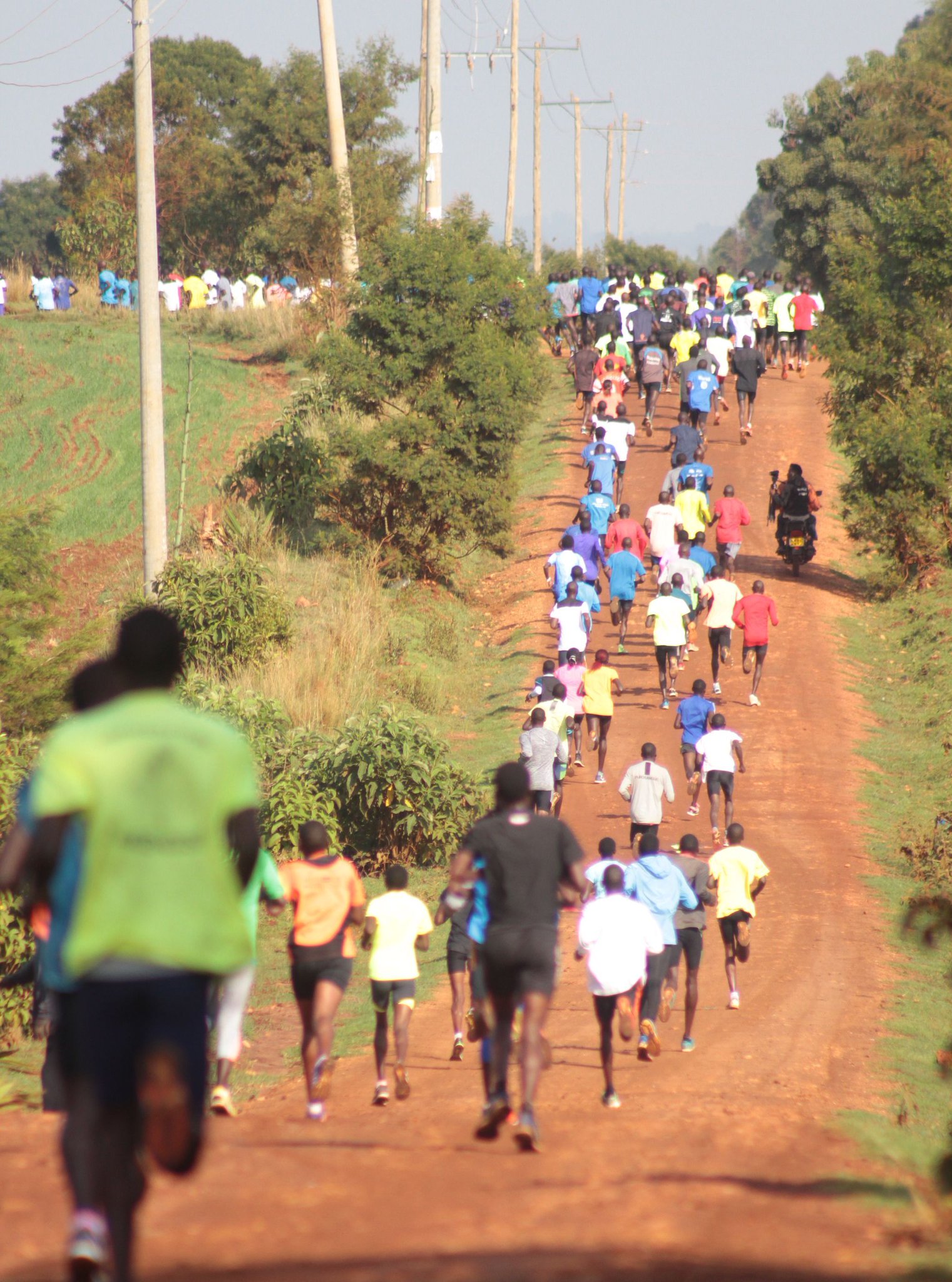
Kenyan Fartlek: My favorite fartlek workout for this time of year is 1 minute on at 5k pace and 1 minute off at recovery pace. As you can see from the picture below, this is a famous workout done in Kenya with hundreds of athletes. The Kenyan Fartlek can be run in a park or on the track and is great for those windy or cold days when it’s hard to hit times in a more structured workout on the track. For our higher mileage athletes, we start our running at 30-40 minutes total, and for our lower mileage athletes, they run for 20 minutes total. Like the 200-meter repeats, I’m not overly concerned about their recovery pace and just want them running.

Threshold Reps

For those of you who have been following this website for a while know I love threshold reps. Threshold reps can be difficult especially for younger athletes. During the beginning of the track season reps can be shortened to 800-1000 meters. After each repetition athletes take 1 minute standing rest. For the threshold reps in the beginning of the season 60-75 seconds slower than their mile PR pace is a great starting point. Athletes who run more mileage (greater than 50mpw) can shoot for 8,000 meter worth of volume and athletes running less can shoot for 6,000 meters worth or volume.

Strides: This last one isn’t really a hard workout, but more of a reminder to keep in strides during the winter. Strides performed after distance runs can help athletes transition to faster track workouts, ensuring that they maintain their speed. I like to rotate between doing 6×50 meter strides and 6×100 meter strides, When we run 50 meter strides, I notice the younger athletes, especially, will run significantly faster. It’s important to incorporate these strides early in the season to help bridge the gap from distance runs to faster track workouts.