What I look for in a cross country meet

I’m currently working on our cross country schedule for the 2023 season. It seems like I have been falling behind other coaches on getting this done! As I put together our schedule I usually think about the following things before committing to a meet.

2019 Flower Mound Invitational at Lake Park in Lewisville

  • Meet Management: When our team goes to a meet I hope it is well run. The meet starts on time, results are posted, course is accurate in distance, and there are enough bathrooms for the runners. Extra bonus if a meet has starting boxes!
  • Course Quality: Course is well maintained, wide starting line, well marked, wide enough course to allow passing and avoid bottlenecks. This is high school cross country and I don’t expect, nor do I want my team to run on a golf course. I do try and avoid courses that have too many rocks or holes. We are trying to build towards district not find a way to sprain an ankle.

Watch out for gopher holes at the Region 1-6A Championships in Lubbock

  • Meet Competition: Each year is different. With experienced teams I may look for a more challenging schedule. If we have a younger team we may try and find meets that will build our confidence. We are fortunate in North Texas to have both options available without having to travel out of town. For individual athletes who are looking to place high at state I think it’s important they face strong competition. We want them to be pushed and mentally prepared for what they will see in the postseason.
  • Number of Meets: I usually schedule 6-7 meets in a season. Our varsity athletes who have more experience may only run 4 meets before the start of district. I know the UIL allows us to have eight meets in a season, but that seems excessive and requires us to race every weekend starting in the middle of August. I think it’s great for JV and Varsity athletes to have a time during the season to focus only on training.
  • Timing of the Meet: We like to test ourselves at the beginning and end of the regular season. First meet I like to see how we are doing after our summer training. Towards the end of the season I want to see how we have progressed and make sure we are sharp and ready to go for district. This year our first 5km cross country meet is at the Telaneus Invitational. This meet is one of the biggest most competitive meets in the DFW area. Our last regular season meet is the Nike South Invitational. Each year we look forward to racing the best teams in Houston and who knows what teams will also make the trip to run at the Nike Regional Course in The Woodlands.
  • Proximity: Sometimes it’s just nice to hop on a bus and get there within 15-20 minutes. Families will usually travel and cheer on their child if the meet is closer.
  • Tradition: Many times I like to go to the same meet each year. For example the Telaneus Invitational is the same course and it gives us a great gauge/idea on our level of fitness. We can look at our finish times and examine our splits and finish times from previous years.
  • Coaches Hospitality: This isn’t the most important, but it’s nice! Some meets are long and it’s hot in Texas! Water, Gatorade can go a long way for coaches that are running around the course coaching their team.
  • Meet Start Time: I usually try and avoid meets that start at a later time in the morning. If we are going to a meet in August or September I don’t want my athletes running at race past 11 AM. It’s just too dang hot and it does not build confidence or give any indication of an athletes fitness. Meets typically have the JV runners compete last and for some of these kids it’s hard enough to run a 5k in good weather let alone with the temps climb into the 90s.
  • Try Something New: When creating our schedule I look at adding a new meet to our schedule. We can get in the habit of running the same meets against the same individuals and teams. Running a new course is fun and provides new challenges.
  • Different Distances: In the beginning of the year we like to run shorter distances or run a relay race. I think this is especially great for our freshmen athletes as we try and build their confidence up to race 5km. This year our first meet is the Southlake 3200 on the track. I know it’s weird to start at cross country season on the track, but it’s something all of our athletes can handle. For our returning athletes they can try and set a 3200 meter PR which is a good motivator.

The second meet on our schedule is the Greenhill Relays. The meet format is a 4×1.5 mile relay. Each athlete runs with a glove, which in this meet serves as a baton. I like running the relay because it gets the kids to focus more on the team aspect of cross country.

Nothing like watching distance runners hurdle hay bales @ Greenhill Relays

Coaching Freshman Runners

We just started our summer training with the team, and we have many new faces. I’m currently trying my best to learn all their names. Each year, my goal is to help freshmen have a smooth transition from middle school to high school, considering they had only one month dedicated to cross country in middle school compared to joining a team that trains year round. Here are some of the things we focus on to support our freshmen runners in our program.

Training

To ensure the safety and prevent any athletes from getting hurt or quitting due to intense training, we take a slow approach with new team members. Although I aim to push them, my primary goal is to have the freshmen ready to race three miles when the season begins. During the first week, we keep it simple by focusing on dynamic warm-up drills, running 1-2 miles, and cool-down stretches.

We have seven training groups throughout the summer, with the freshmen starting in group seven, which has the lowest weekly mileage. Below is an overview of our team’s first full week. I believe 10 miles for the first week is reasonable and understand if an athlete needs to take walking breaks.

Building Relationships

During the summer, I prioritize building relationships with our freshmen athletes. I make an effort to arrive at practice 15 minutes early to greet them by name (if I can remember!) as they enter. After their workouts, I ask them about their run and tell them good job before they leave. Although it may seem simple, I hope that by the end of the summer, we will know each other better and feel more comfortable communicating.

I also encourage our veteran athletes to welcome and learn the names of the freshmen. We discuss the experience of joining a new program and emphasize the importance of being friendly and welcoming to all athletes. Additionally, once a week, we have a team breakfast at one of the athletes’ houses. I intentionally do not attend these breakfasts, as it provides an opportunity for the team to bond and get to know each other without the coach present.

Learning about Running

Summer practices serve as an opportunity to educate the freshmen about the basics of running. Topics such as the significance of proper footwear and nutrition in the morning are discussed during our morning meetings or in a more casual manner after their workouts. For instance, we recently talked about the equation “STRESS + REST = GROWTH.” As the freshmen experience the stress of daily running, we emphasize the need for adequate sleep to facilitate recovery and growth as athletes.

We also address the importance of having appropriate running equipment. Often, we find boys wearing excessively long shorts or girls opting for thick, oversized cotton shirts. We discuss the benefits of wearing breathable lightweight materials, especially during the hot summer months. It’s worth noting that running clothes are available at various stores in our area, and they don’t need to be expensive brand items like Lululemon for our practices.

In addition to running attire, we encourage our athletes to replace their middle school gym shoes with 1-2 pairs of running shoes. If possible, we suggest having two pairs to rotate during the summer. This practice helps prevent overuse injuries and allows the shoes to air out for a couple of days.

Safety

One of the most important topics we stress over the summer is safety while running. We make sure they understand the importance of utilizing sidewalks whenever possible. In cases where sidewalks are unavailable, we instruct them to always run against oncoming traffic. Additionally, we emphasize the significance of waiting for vehicles to come to a complete stop before crossing streets or intersections. Lastly, we strongly encourage the practice of having a running buddy. As our groups can sometimes spread out, it is essential for athletes to have a teammate with them for added safety and support.

Freshmen athletes with running experience

One last thing. We are fortunate to have running clubs and summer track programs in our area. It’s not uncommon for us to get athletes in high school that have previous running experience. With these athletes we talk about their training experience and try to put them in the correct training group. Usually I err on the side of caution and have them run the same or less mileage than they did in middle school. I do this because our training is still most likely different and they will need time to adjust. I also feel that most middle school kids are like all other runners and occasionally overestimate their weekly mileage.

One-Time
Monthly
Yearly

Make a one-time donation

Make a monthly donation

Make a yearly donation

Choose an amount

¤5.00
¤10.00
¤20.00
¤5.00
¤15.00
¤100.00
¤5.00
¤15.00
¤100.00

Or enter a custom amount

¤

Your contribution is appreciated.

Your contribution is appreciated.

DonateDonate monthlyDonate yearly

Cross Country Summer Training

The track and field season has come to an end, and now it’s time to turn our attention to cross country. Summer training is when athletes put in those early morning miles to reach their team and individual goals. I have always enjoyed summer training and see it as an opportunity for our team to bond and reach new levels of fitness together.

Below are four types of runs that we focus on during the summer.

Long Run: 20% of an athletes weekly mileage. During the season the pace of the long run is faster, but during the summer we relax more and focus on getting the distance in for the day. With the heat I’m not going to push an athlete for an extended period of time.

Distance Runs: These runs make up the majority of our summer training. We maintain a pace around 2:30 minutes slower than an athlete’s mile PR. These are my favorite runs as they provide an excellent opportunity for team bonding, as we run at a conversational pace.

Mile Pace Work: Throughout the summer we have one workout a week that is focused on mile pace. Start with something as simple as 4×200 and build to 12-16×200 at mile pace towards the end of the summer. Gets athletes out of the plodding and helps when we transition to more serious work in the fall.

Progressive Runs: Again because it’s hot we try and focus on finishing one to two runs a week faster. For example a 5 minute miler would run 4 miles at 7:00 pace and then 2 miles @ 6:00 pace. Workout isn’t crazy hard and they feel good to have finished strong and fast.

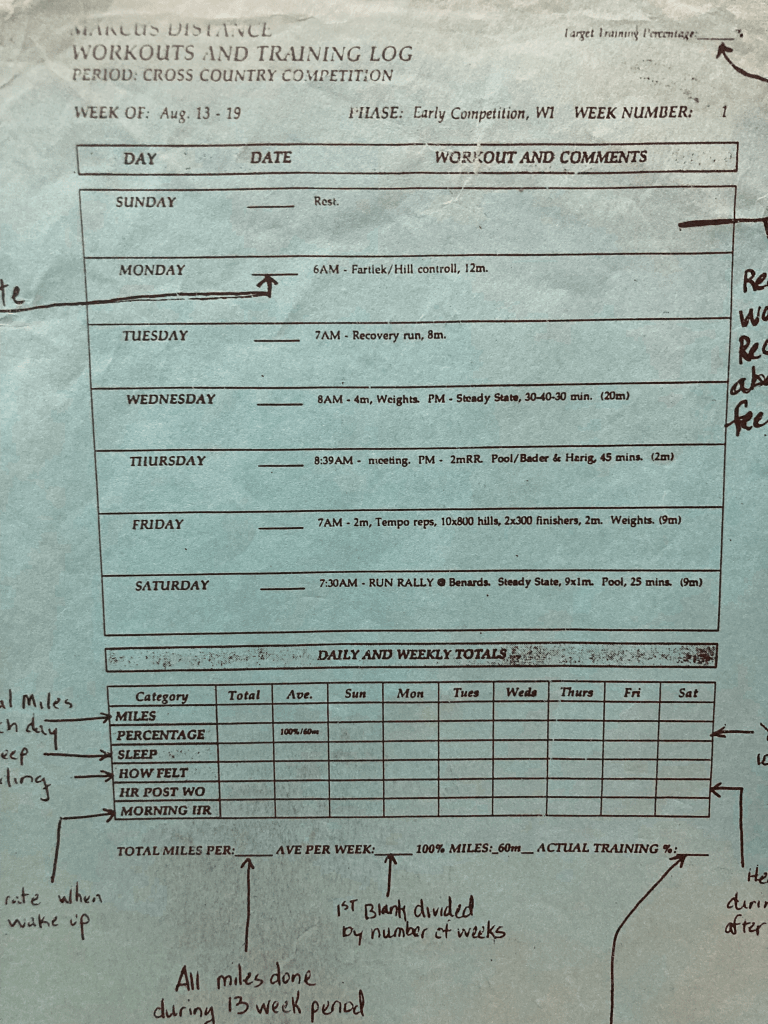
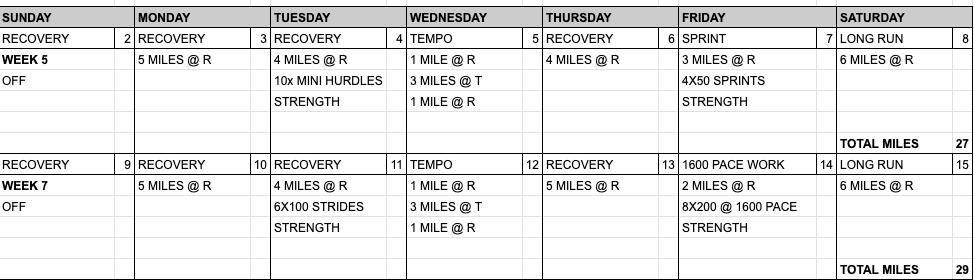
We track our summer training on a google document. I know many teams use training logs and record their mileage in a notebook. We did this as well when I was a runner at Marcus High School. Our coach Steve Telaneus did an amazing job of focusing on the details and it showed in our training logs.

Marcus Cross Country Training Log– 1997

Flower Mound Cross Country Training Log- 2023

While our training logs may have different formats, most of our training remains the same. Usual tempos/progressive runs, strides, hills, and of course recovery/distance runs. No matter the training I think the teams that are most successful in the fall are the teams that were the most consistent in the summer.

Good luck to all teams this fall and I hope everyone has a great summer!

Steve Telaneus: Developing a Successful Cross Country Program: The Complete Guide from A to Z

Most Popular Running Shoes, Then and Now

I recently took a poll and asked our cross country team what shoe brand they wear for our easy distance runs. I was surprised by the results.

Back in the 1990s, when I was in high school, Asics was the most popular brand amongst runners. We believed that a serious runner should only wear a serious running shoe, and that brand was of course Asics. Our high school coach even provided the varsity team with one pair of shoes each year, which were always Asics with the famous gel cushioning. If an athlete was willing to spend extra money, they would usually buy the Asics Gel Kayano. Looking back, I find it amusing that a group of high school runners were wearing heavy, structured cushioned shoes

Asics Gel Kayano from 1993-2009- Not the best looking shoe!

When I moved on to run at Texas A&M University, we were sponsored by Nike. We had two choices of shoes: the Nike Pegasus and the Nike Structure. I wore both shoes and don’t remember having any issues, except for achilles tendonitis when I ran 110-120 miles a week during my senior year. That was due to overtraining, and I can’t blame the shoes for the injury.

We did workouts in a Nike flat (can’t remember the name), and races in the Nike Zoom Kennedy spike. Bob Kennedy was the greatest runner in the United States in the 1990s, setting American records in the 3k and 5km races. Running is different from other sports, as we usually only have a few famous runners to get excited about. Everyone still knows Steve Prefontaine, but in the 1990s, we had Bob Kennedy

Nike Zoom Kennedy- THE spike of the 1990’s

.

TEAM SHOE POLL

  1. Nike- 20
  2. Saucony- 9
  3. Hoka- 7
  4. Brooks- 6
  5. Asics- 5
  6. New Balance- 1
  7. On Running- 1
  8. Adidas- 0
  9. Under Armour- 0

Nike continues to be the champion in the shoe battles. I discussed this with some of our athletes and we think it’s because Nike’s shoes are readily available in all sports stores. You can visit Dick’s Sporting Goods or Academy and find a wide selection of Nike running shoes and apparel. Nike has also done a better job of creating shoes suitable for both slow, easy distance runs and intense workouts. Our athletes like the Nike Pegasus, Nike Zoom Invincible, and for hard workouts, the Nike Vaporfly.

Saucony is the second most popular brand on our team. The girls, in particular, seem to prefer the Saucony Endorphin Speed 3 and Saucony Triumph.

Hoka has become popular among our team, with 7 athletes wearing shoes that were once only used by ultra-trail runners. Hoka’s are now worn by walkers, runners, and people who spend a lot of time on their feet at work.

Brooks is a popular choice among our boys team for easy distance runs.

The low popularity of Adidas was the most surprising result for me. They make good shoes, but kids aren’t currently interested in wearing them.