Nike Cross Nationals Experience

Qualifying for Nike Cross Nationals (NXN) is a once in a lifetime experience for athletes and coaches. The top two teams from the nine district regions and four at large teams qualify for a total of 22 teams. In addition to the 22 teams the top 5 individuals from each region also qualify.

Below is the agenda from the this years NXN. Nike does a great job of planning the event and takes care of everything from travel, lodging, and meals. As a coach this is the least stressful out of town meet we attend because I don’t have to worry about the logistics.

Day One Travel and Visiting the Nike Campus

Our travel on the first day was straightforward with a direct flight at 9 AM departing for Portland. Everything went smoothly and we were picked up by the Nike Charter bus and taken to the Embassy Suites in Tigard. The hotel is very nice and is only available for nike employees, athletes, and coaches for the duration of the event.

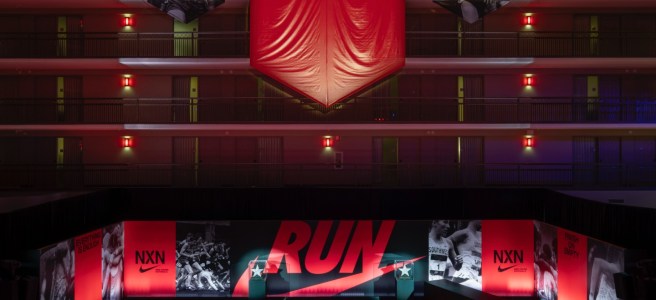
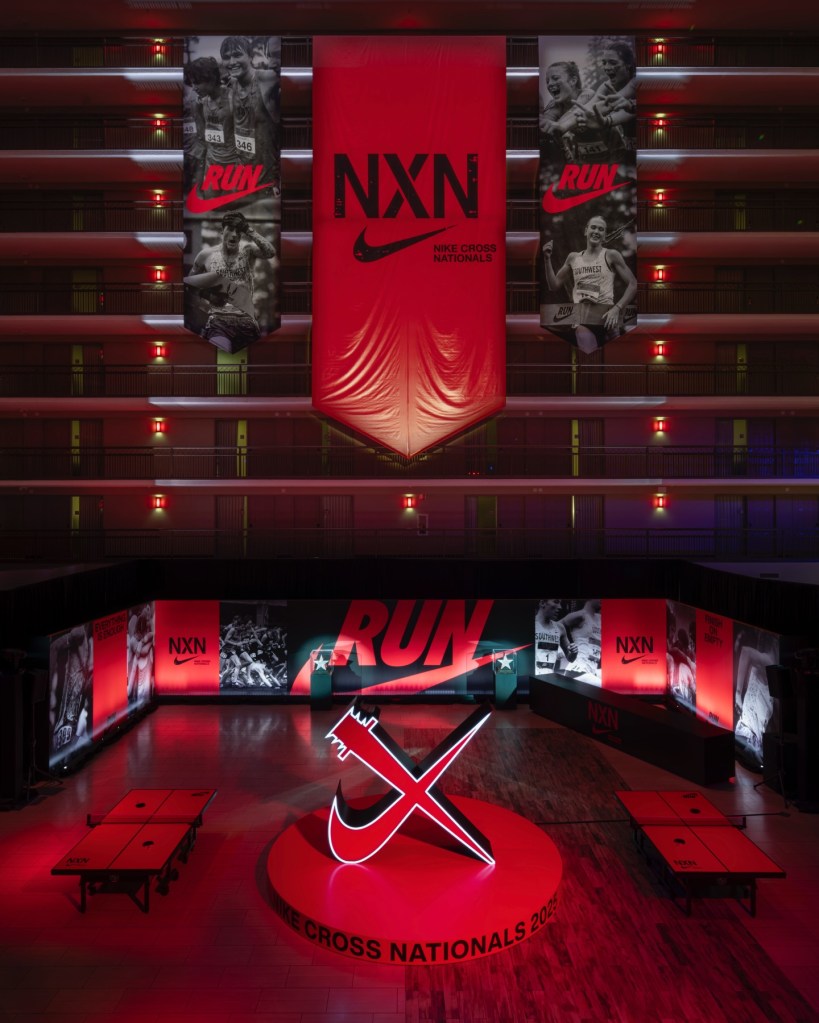
Embassy Suites Lobby decked out for NXN
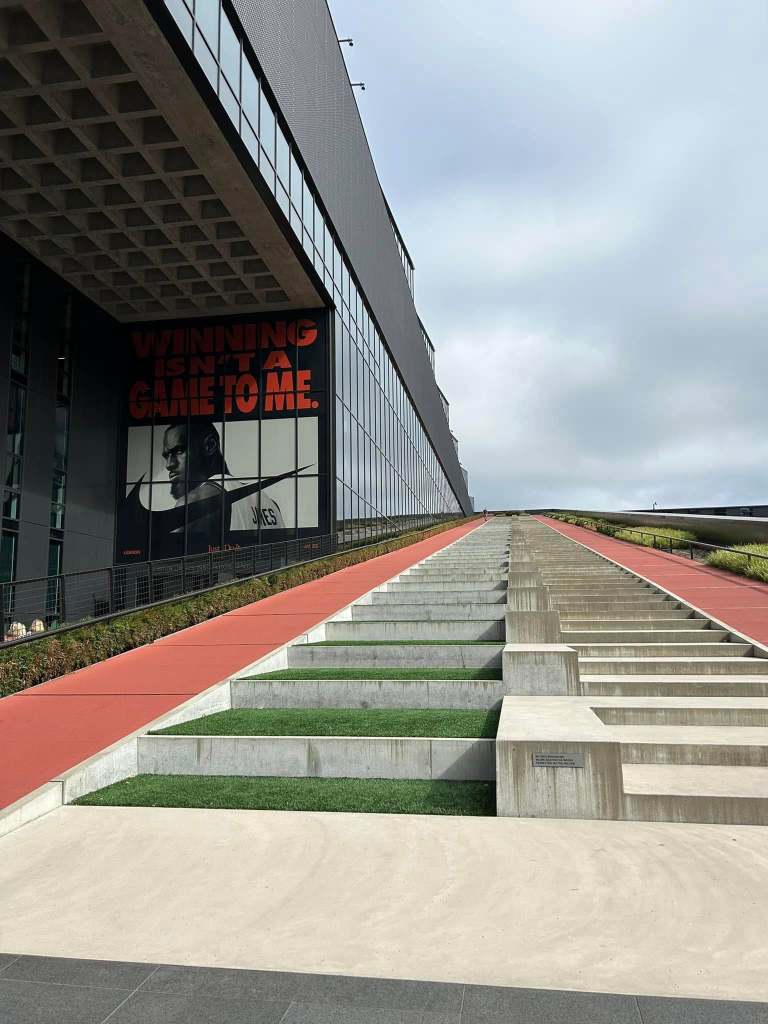
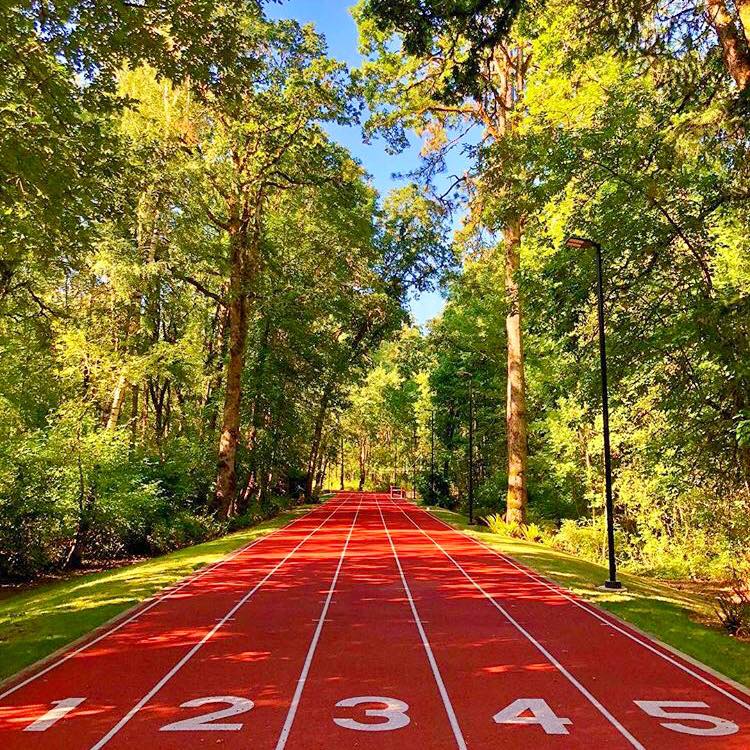
After getting checked in at the hotel athletes are taken by charter bus to the Nike Campus. This is one of my favorite parts of the trip. Getting to run on the wood chip trail and the Michael Johnson track is always special. This year I decided to also tackle the big incline pictured below. Was a fun challenge even though I did feel my achilles straining toward the end.

Nike Incline
For the workout on Thursday our girls ran 2 miles plus 6×200 @ 3200 race pace plus another 2 miles on the hollister trail. Nothing crazy and good way to shake out the legs after traveling to Portland.

After our workout Nike has a big opening ceremony on campus where they introduce all of the qualifying teams and individuals. Each year they also interview Nike Elite athletes like Grant Fisher, Cole Hocker, and Karissa Schweizer. Always great to see these elite athletes and appreciate the advice they provide to athletes and coaches.

Michael Johnson Track
Day Two Course Preview and Nike Gear

Day two is dedicated to checking out the course and receiving all the Nike gear. The Nike South Region has historically had the blue kits which I like since Flower Mound’ school colors are navy, silver and white.

In addition to receiving the gear for the meet athletes also get a chance to run on the course. The course this year like most years was very muddy. Nike ropes off the main course and has us run on the “gator trail” which is what is used by the lead gator on race day to film the race.

For our workout we ran the first half of the course and then added another 1.5 miles on the Glendoveer wood chip trail that circles the perimeter of the course. After our three mile run we added on 4×30 seconds at race pace. Usually we do this from the start line, but with the muddy course I felt it was best to just run on the wood chip trail.

Day Three the NXN Race

Day three is the big race day. Our team’s focus was to run our best race. That meant running as a team, maintaining a controlled but fast start, passing athletes in the middle of the race, and lastly finishing strong. Easier said than done. We had a disappointing race the year prior, and I felt that was my fault for having the athletes too focused on other teams and the overwhelming fast start.

On the morning of the race, we left the hotel at 8:45 a.m. and arrived at the course around 9:30 a.m. The girls went to the athletes’ village and their designated team space and tried to stay relaxed. I always get anxious at meets and decided to go ahead and cheer on the teams and individuals from the Nike South Region in the boys’ race. At first, I told myself to just walk around and cheer without getting too excited. Of course, before I knew it, I was sprinting around and cheering on Caden Leonard from Southlake. His dad, Justin Leonard, is the coach at Southlake, and I always try to cheer on coaches’ kids…even when they are competitors.

After the boys’ race, our girls did their usual ten-minute warm-up, followed by drills, and then went to the finish line to be recognized before the start of the race. The “athletes run out,” as it’s called, is great for the spectators at the event and those watching online. For coaches and athletes, however, it can be stressful as they try to time their warm up and stay focused on the race ahead.

After the athletes’ run out, we had just enough time to do a few more drills and several strides before the start. When the gun went off, I positioned myself by the first turn to see how well we got off the muddy starting line. It’s always hard to tell exact placement at NXN because there are 45 individuals who don’t count toward the team score, along with so many great teams. I could tell we were around the middle of the pack, which was good for us.

When the splits started coming in, I was very excited to see that we were in the top five for most of the race. Our girls did a great job of running as a pack and holding their position through much of the race. We did fall back slightly over the last kilometer but managed to hold on for a top ten finish, placing ninth overall. I was pleased with our pack running; we had a gap time of 28 seconds from our first to fifth runner. Our fifth runner was the fourth fastest fifth runner among all teams. In years past, we’ve had strong front runners but have struggled somewhat at the fifth spot, so it was encouraging to see improvement in that area.
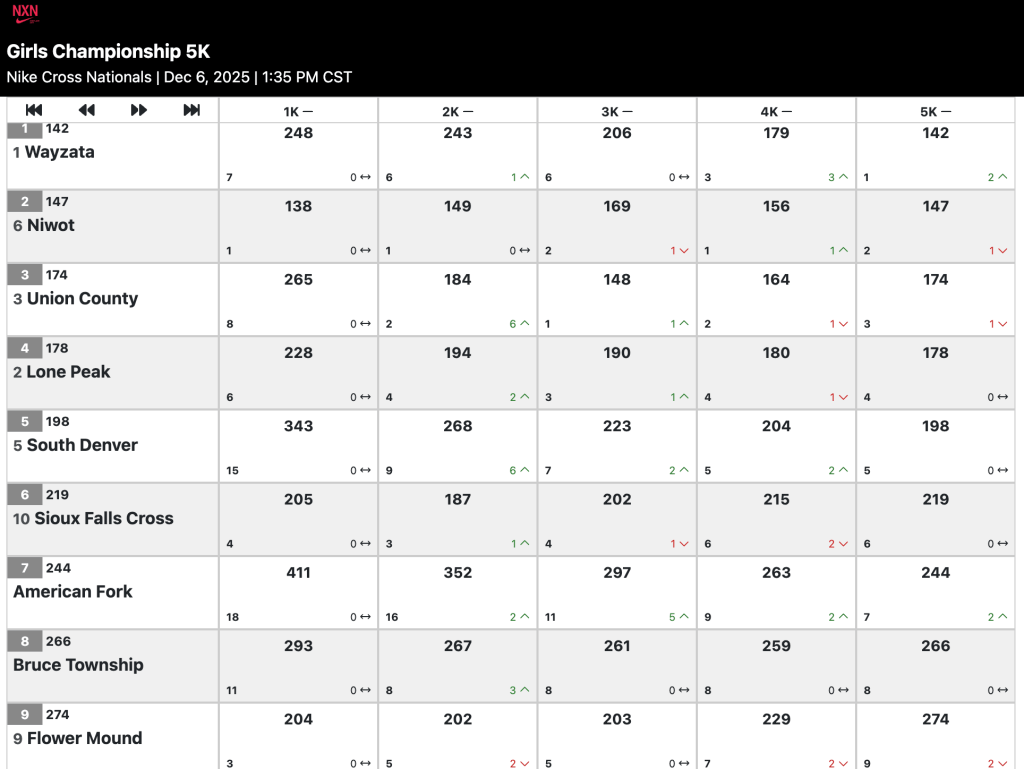

After the race we headed back to the hotel for lunch and a shower. I was exhausted from the long day and also took a nap. That evening Nike recognized the top individuals and teams after dinner. I have been fortunate to attend NXN a few times and have noticed the teams getting recognized are the same ones every year. Very impressed with those programs!

You can see the NXN Appearance Stats at this link

Afterwards the athletes had a dance party (maybe their favorite part of the trip!) and I decided to relax in my room and take a deep breath after a long and fortunately successful season.

My thoughts on NXN and why it’s so difficult

The Challenge of Elite Competition

This is probably obvious, but the level of competition at NXN makes racing extremely difficult. Every team and individual is elite, yet there can only be one winner. Many athletes who are accustomed to racing at the front of their state meets suddenly find themselves in the middle or even the back of the pack. Fast starts that normally put them near the lead are unlikely with so many top teams and aggressive front runners. In the years we performed well, our success came from racing as a team and focusing on passing runners throughout the race. Focusing on overall place especially early can quickly become discouraging.

Disruptions to Routine

Most athletes at this level thrive on consistency and routine, from sleep schedules to pre-race meals. Traveling to the West Coast and adjusting to a different time zone, along with unfamiliar meal timing, can disrupt an athlete’s rhythm. Even the warm-up becomes more difficult to plan. Nike introduces all teams and individuals before the race, and the timing of those introductions affects when athletes warm up, do drills, and complete final strides. This year, our team chose to warm up first, go through introductions, and then finish with strides at the finish line. It’s not a major issue, but it is a departure from what athletes have done all season.

A Deceptively Difficult Course

The NXN course itself adds another layer of challenge. Many look at the elevation profile and conclude it isn’t very hilly, and that’s largely true. There are really only two significant hills: one around the halfway point and another right before the finish. However, the placement of the final hill is especially demanding and creates an opportunity for strong athletes to pass runners who are struggling late in the race. What truly makes the course difficult particularly for teams from Texas and California is the soft footing. In our multiple trips to NXN, the course was dry only once. That soft ground drains energy and, in my opinion, favors strength-oriented runners. Athletes who excel at the 800 and 1600 during track season may find this course especially challenging.

One-Time
Monthly
Yearly

Make a one-time donation

Make a monthly donation

Make a yearly donation

Choose an amount

$5.00
$10.00
$15.00
$5.00
$15.00
$100.00
$5.00
$15.00
$100.00

Or enter a custom amount

$

Your contribution is appreciated.

Your contribution is appreciated.

Your contribution is appreciated.

DonateDonate monthlyDonate yearly

NXR South Championships

After our state meet in Texas we had three weeks till the NXN South Region race. When you have a race that requires all of your physical and emotional energy I feel it’s important to be careful the following week. We kept our mileage consistent, but dialed down the intensity. The one workout we had was a 3-2-1 fartlek on the grass for 30 minutes. We usually are more structured in our workouts, but I felt it was important to let our athletes go more by feel. The three and two minute repetitions around tempo pace and the 1 minute repetitions close to 5k race pace. In between the repetitions a 1 minute easy jog to allow adequate recovery. In addition to the one fartlek workout we also had a medium long run on a hilly route in Flower Mound.

Westchester Park in Flower Mound. Only grass park we have within couple miles of Flower Mound High School

The next two weeks we returned to our usual cruise intervals on grass at our local park. We do something similar to what is listed below throughout the season.

Girls

Workout A: 1 mile warm up, 400 meters fast, 6-7xkm @ tempo pace, 400 meters fast, 1 mile cool down

Workout B: 1 mile warm up, 600 meters fast, 5-6×1200, 200 meters fast, 1 mile cool down

Boys

Workout A: 2 mile warm up, 600 meters fast, 8-10xkm @ tempo pace, 400 meters fast, 2 mile cool down

Workout B: 2 mile warm up, 600 meters fast, 7-8×1200, 400 meters fast, 2 mile cool down

We also had two track workouts that we focused on running at our a little faster than 5k pace

Girls and Boys Track Workout leading up to NXN South

Workout on the track: warm up, 2 (2×400, 1600), cool down. Recovery was 200 meter jog between 400’s and 3 minute standing rest after the 400’s and 3 minute rest after the 1600’s.

Our top girl athlete ran the workout in 5:26, 69, 71, 5:14, 70, 69.

One of our girl pack runners (6-10 on team) ran the workout in 5:56, 76,81, 5:59, 80, 78

NXN South Region at Texas A&M University

The NXN South Region race had previously been held at Bear Branch Park in The Woodlands. The course was known for being narrow and when it rained very muddy. We had mixed results at Bear Branch Park and some years when it was muddy it felt like whoever could sprint the fastest the first 600 meters had a good chance of going to NXN.

As participation continued to grow, the event required a new venue to accommodate runners and spectators. The Texas A&M course meets the requirements to not only host a large high school invitational meet, but also NCAA Championship races. The starting line is almost 100 meter wide to comfortably handle 30 teams and individual athletes. The course begins with an 800 meter wide straight that allows athletes to safely merge before the first turn. The rest of the course remains wide, includes rolling hills, and finishes with an 800 meter straightaway. I think this course is a big improvement over Bear Branch and I like that high school kids have the opportunity to race on a collegiate level course.

Middle mile at Dale Watts Texas A&M Cross Country Course


Flower Mound Girls NXR South Race

Going into this race I tried to make sure we stayed sharp and fresh after a long cross country season. Our girls were disappointed by a second place finish at state and we tried to use that as motivation going into the NXR South Race. I felt if we could hammer up front and run as a team we would have a good chance of qualifying again this year.

The start of the race was moved to 7 AM to avoid thunderstorms that were predicted to roll into College Station by noon. We have had early starts to beat the heat before, but 7AM in November felt very early. I looked at the weather app on my phone and it said the sun wouldn’t even rise till 7:10 AM. The race was recorded on milesplit and it’s hard to even pick out the runners the first couple miles because it was still dark.

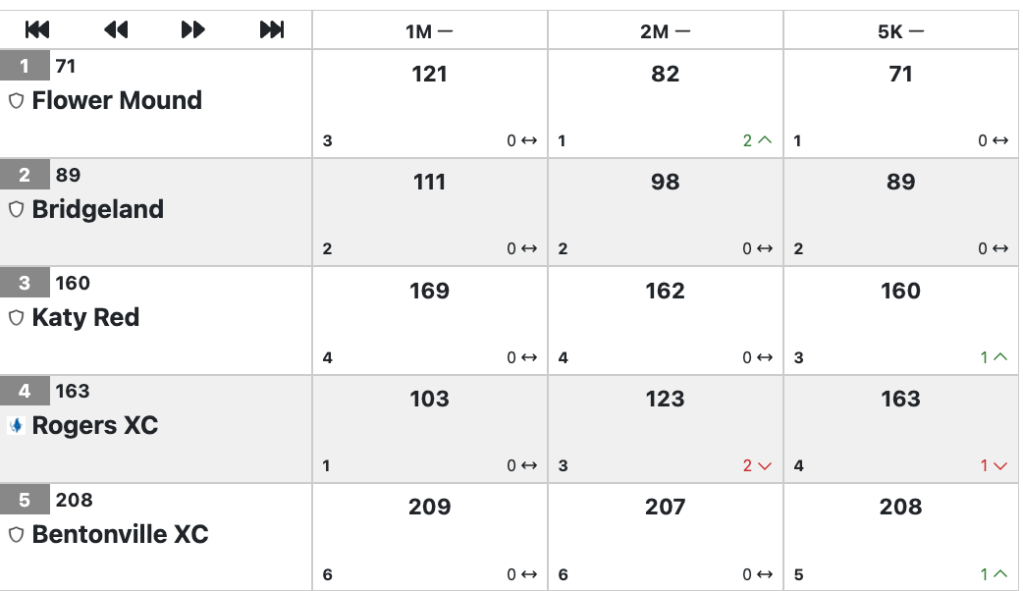
The race did start exactly at 7AM and I stood close to the kilometer mark awaiting our team. We looked like we had a good start, but it was tough to tell with many of the teams wearing different club uniforms. When the score populated for the first mile we were in third place with 121 points. From looking at the other regions and national rankings I thought we would have to place in the top two to earn at spot to NXN. I wasn’t ready to panic at this point and felt there was still plenty of time to move up, especially with the rolling hills in the second and third miles.

Split scores for NXR South

We ran great in the second mile with our front three runners all in the top 20 for team scoring. Our fourth runner moved from 36th to 28th place and our fifth runner moved from 57th to 33rd. We were now in first place and I felt like we had a great chance of advancing to NXN, but still wanted us to finish better than we had at state.

I ran to the finishing straight which is almost 800 meters long to cheer on our runners. It’s pretty brutal to see the finish banner and still know you have 2-3 minutes of the race remaining. Our girls looked to be holding their positions or passing other runners. When the scores originally populated it showed that we finished second. I was disappointed to see that we had come up short again after leading at the two mile mark. When I looked closer at the results I noticed that our number one runner was missing. I sprinted to finish line and was worried that she was hurt or maybe had passed out from the effort and was unable to finish. When I got to the finish line she informed me that she did more than just finish and had passed a couple runners to finish in eight overall and first in the team scoring.

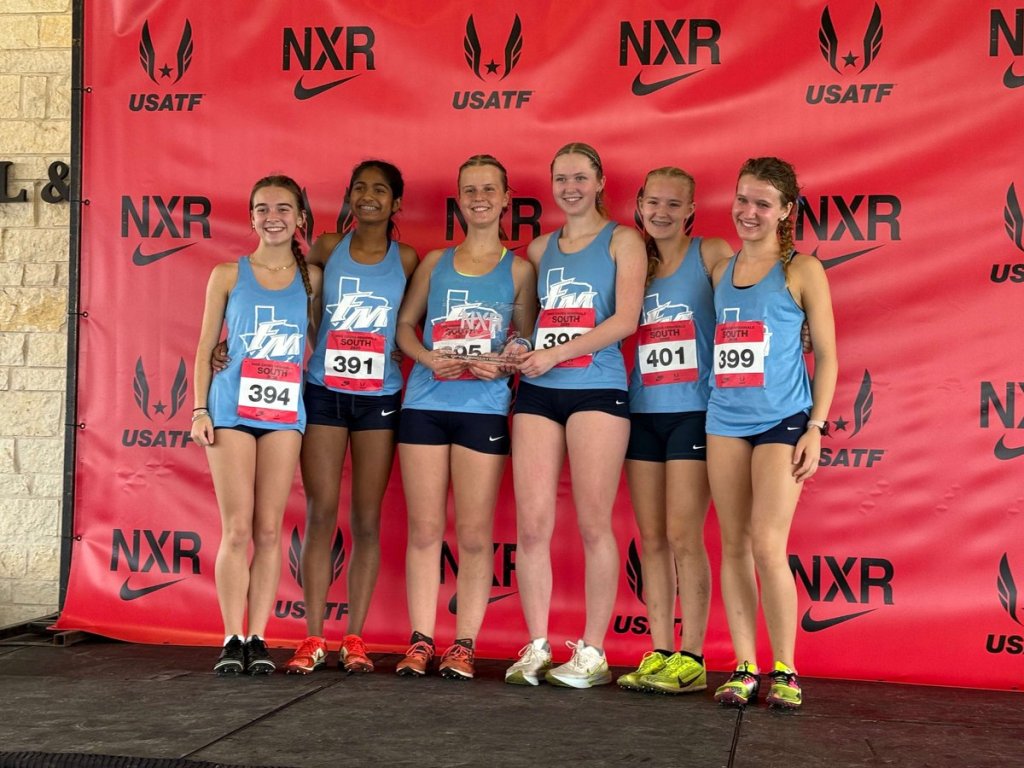
Fortunately the results were fixed quickly and when they added our number one runner in the results we had won with 71 points. A very low score for a meet with 33 teams and great competition.

NXR South Winners

I also want to add I’m very proud of the way our JV girls competed in the open race to place first. They worked hard all year and put in a great performance after not racing since mid October.

NXR Open Championship Winners

I’m on a roll with two posts in one week! I’ll try my best to get another post in soon on the Nike Cross Nationals experience.

One-Time
Monthly
Yearly

Make a one-time donation

Make a monthly donation

Make a yearly donation

Choose an amount

$5.00
$10.00
$20.00
$5.00
$15.00
$100.00
$5.00
$15.00
$100.00

Or enter a custom amount

$

Your contribution is appreciated.

Your contribution is appreciated.

Your contribution is appreciated.

DonateDonate monthlyDonate yearly

Thoughts on the Texas UIL State Cross Country Meet

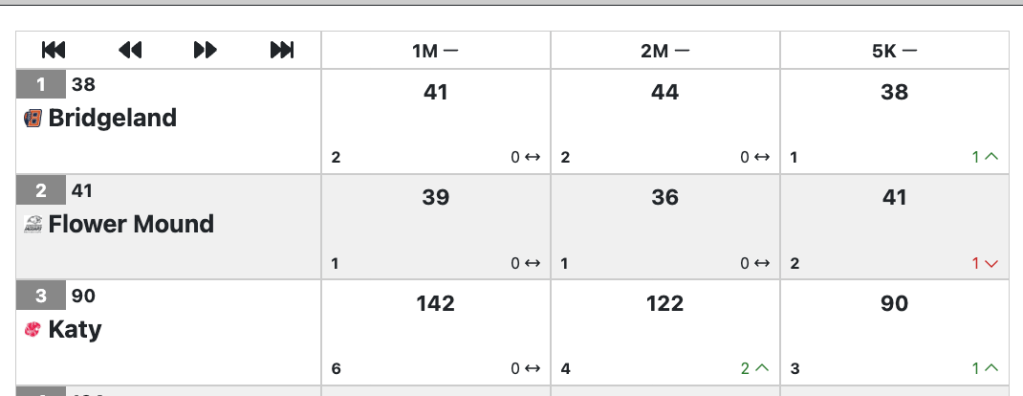
This year marked the 30th year the UIL has hosted the Texas State Cross Country meet at Old Settlers Park. Our team had hopes of continuing our state run and going for a sixth consecutive state championship. We unfortunately came up three points short to a great Bridgeland girls cross country team. My thoughts are below on the state meet course and the Flower Mound girls team race at state.

OLD SETTLERS PARK COURSE (1996-2025)

THE START

The start is significantly better now with almost 600 meters before the first turn. I would like to see the UIL widen the start line and use the full width of the available field. There was a point we could line up 7 runners on the starting line and now we are able to line up 4-5 athletes. With that said the start line used to be on a sidewalk, not fun if you are wearing spikes. The first turn was also only 200 meters after the start and usually had a significant number of rocks to trip up runners.

State meet course from 2013. Short distance to first turn and narrow!

COURSE WIDTH

If people are asking why athletes in Texas like to get out fast, maybe the old state course is partially to blame. Besides the short distance to the first turn the rest of the course was very narrow. Good luck passing runners when you could only run three wide for significant portions of the race. There were also zero barriers and that allowed spectators to press in on the athletes an make the course even more narrow especially as they approached the finish.

The course is now significantly wider and athletes are able to pass other runners when able. The UIL has also increased the number of barriers for athlete safety. It is now difficult for an overzealous parent or coach to impeded athletes by stepping onto the course. The barriers clearly help mark the course and keep spectators a safe distance away from the runners.

FINISH

The finishing straight is approximately 200 meters and the UIL has added seating for the spectators. Not everyone can run or walk around the course and it’s great their is an option for people to watch the start and finish from the same area. The finish wasn’t bad when the course was first used, but there was no seating and it was hard to get a good viewpoint of the runners.

Current state meet course. Better for athletes and spectators

STRIVING FOR A SIXTH STRAIGHT CHAMPIONSHIP

Winning is hard and repeating is harder. Many teams and individuals each year have the same goal of being a state champion. I doubt a team that has placed second or third the year prior has written down on their goal sheet “Geez I sure would like to get on the podium again!” Of course they probably would like to ascend to the top of podium and hold up that first place trophy.

We have continued to win by being focused on preparation and consistency. Our team motto is “prepare to win” based upon the quote by Juma Ikangaa “The will to win is nothing without the will to prepare.” Throughout the year I thought we did a great job of having good workouts and having a positive team culture.

Going into the state meet I thought it would be a close race between ourselves and Bridgeland. They had a great track season the previous spring and were unbeaten against teams in Texas. With a strong front three runners and a great pack it reminded me of some teams that we had at Flower Mound in the past. Our team this year has had two to three front runners and our pack has shown hints of greatness, but also inconsistency over the course of the year.

Before the race I focused our team on having a good start and running well in the middle mile. The middle mile is the most difficult and is a great opportunity to stay focused and pass runners. I also wanted our girls to run as a team and push each other throughout the race. I don’t like to focus on any one team or individual, but made it a point that the Bridgeland girls would be the biggest threat.

During the race we had a decent start, but Bridgeland set themselves up better with three runners in the top seven. Even though we had a two point lead at the mile mark, I think having three athletes in the top 10 allows a team to run more freely. We followed our race plan the second mile and did a great job of maintaining or passing runners. I was running around the best I could encouraging our athletes while trying not to run into other coaches and spectators.

Going into the last mile we had an eight point lead. I thought we were in great position but we had to finish the race and especially the last kilometer. The Bridgeland girls began to pass runners and I noticed that we were maintaining or losing spots. Not what you want to see! Unfortunately when the scores came in I knew that we had already lost.

Once I had time to calm down and analyze the results I thought we ran a great race and competed very well. In fact I think it was our best team race of the season. I haven’t checked results from every state meet in history, but feel confident we scored the lowest second place total in Texas 6A cross country history. Proud of our girls team for how they competed and all the hard work they put into to help us continue to be one of the top teams in Texas.

I’ll have another post soon on the NXN experience and may also add another post on what a typical training week looks like for an NXN qualifying team.

Running In The Heat Part One

The school year is over, and we are now officially beginning our summer training. Everyone wants to have a great summer so we can do well in the fall cross country season. Unfortunately, in Texas, the summer is the most difficult time to train. The heat and humidity can be unrelenting, and it’s easy to struggle with our training and stay motivated when the low temps for the day creep into the 80s, and the highs surge past 100 degrees.

I went to school at Texas A&M University and ran on our cross country and track teams. During the summer, I chose to run at night instead of in the morning. I found the humidity to be slightly better at night, although the temperature was higher. Somehow during my senior year I managed to run over 100 miles a week. It wasn’t particularly easy, but I don’t remember letting the weather get the best of me. I was focused on the fall and felt that the summer weather would only make me tougher.

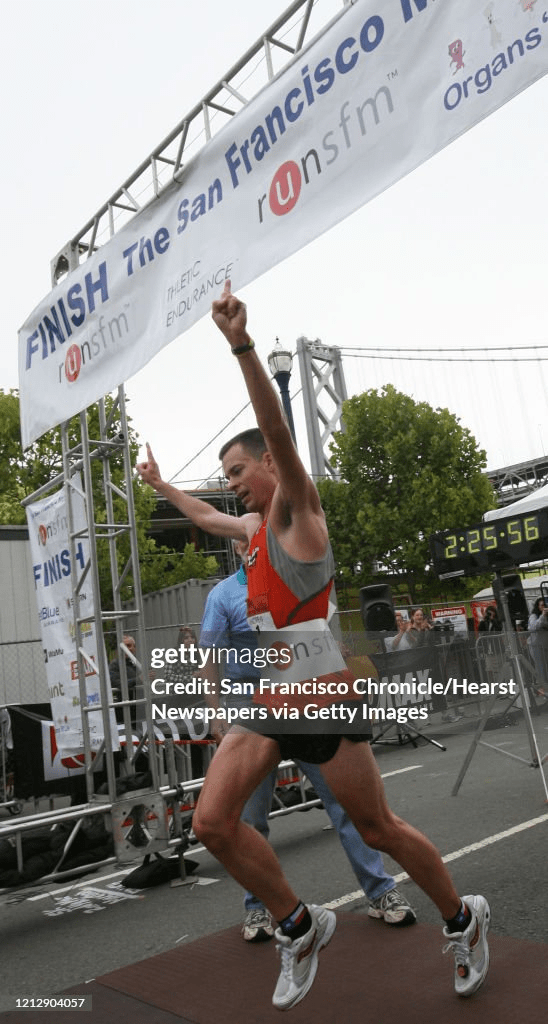
When I graduated from Texas A&M, I began to train for marathons. I found training for marathons was easier for me during the summer when I was not teaching and coaching. I won the San Francisco Marathon three times, which takes place in late July, while doing most of my training in the hottest time of the summer.

Winning the San Francisco Marathon in 2007 (long time ago!)

.In this part one of two are some things I have done personally myself or with our team in order to train successfully in the heat.

ATTITUDE

Probably the most important thing is having a positive attitude. The heat and humidity are something that most athletes will have to face over the summer. Complaining about the weather only makes things more difficult for yourself and your training partners. I tried to look at the heat as something that was making me physically and mentally tougher. I felt if I could get in tempo runs or long runs during the summer, then imagine how fast I would be able to run once the weather cooled off.

I also feel that leaders of the team, whether they are the coach or the athletes, need to have a positive attitude. Focus on something other than the heat and humidity. Everybody knows it’s hot, and there’s no point in the leaders dwelling on that fact. For leaders, it’s a great time to focus on something else like the short list below.

Seven Great Positive Thoughts

  • Great to spend time with my friends
  • Great to be doing something I love
  • Great to be getting better today
  • Great to be doing something that makes me healthy
  • Great to be setting a positive example for others
  • Great to be focused on my goals
  • Great to be healthy and able to run each day

MODIFYING WORKOUTS

Obviously, having a positive attitude will only get you so far. When it comes to training, it’s important to adjust paces as necessary and be realistic.

Recovery Runs

For recovery runs, I think it’s best to shoot for 15-30 seconds slower per mile. If the run is to be a recovery run, it’s important that we focus on effort and not become too obsessed with pace. For example, during the spring, maybe an athlete with a 5-minute mile PR runs their recovery days at a 7:30 pace. During the summer, it may be smarter to run closer to 8:00 minutes, depending on the temperature that day.

I also know many athletes and teams have had success by going for runs based on time instead of a set number of miles. For example, that 5-minute miler we just talked about may go for a 40-minute run instead of running for 5 miles. They most likely will get in the same distance, but they will feel less pressure to push for a certain pace they may have run under cooler conditions.

Long Runs

When I was training to qualify for the Olympic Trials I would run every other long run at a hard effort and focus on hitting marathon pace for the second half. I would also run up to 24 miles in order to prepare myself for “the wall” at the end of marathons.

When training for the San Francisco Marathon I had to be realistic. I would keep the distance to 20 miles or less. I also would avoid marathon pace or harder efforts during the long runs and save that for other workouts during the week.

For high school athletes I feel it’s important to keep longs run at 20 percent of their weekly mileage. Like the recovery runs, I would also consider going for a set amount of time when the weather really heats up.

Also, it’s important to make sure there is water available every 30 minutes. Make sure to pick a loop that doesn’t get too far away from the starting point. If running longer than an hour, make sure there is water every 15-20 minutes.

Workouts

For workouts, I prefer to modify the pace, distance, or rest between repetitions to account for the temperature.

One quick example for modifying a 4-mile tempo run at a 6:00 pace:

  • 4×1600 @ 6:00 pace with 1 minute rest on the track. Athletes can stop after each repetition and get water.
  • 2×12 minutes on the road or grass with 2 minutes standing rest. Can focus more on effort and not stress on the exact pace. Athletes can run in a park with access to water.
  • Progressive out and back 4-mile tempo run. Run 2 miles out at 6:15-6:20 pace, turn around, and try to run faster on the way back.
  • 2×15 minutes on the road or grass with 3 minutes standing rest. Athletes can run for a longer time but at a slower pace.

Another way to modify workouts is to adjust paces by running repetitions at one event up from your goal pace. For example, if running a 1600 meter pace workout, maybe shoot for 3200 or 5k pace instead.

CCCAT CLINIC AND HAVE A GREAT SUMMER

I’ll be speaking at the Cross Country Coaches Association of Texas Clinic this summer. Topic is Cross Training for Distance Runners. I’ll be speaking in detail over cross training and ways to implement it into your training.

You can purchase the power point I’ll be going over https://distancecoach.gumroad.com/l/lvzpi?layout=profile

You can register for the clinic at this link https://www.cccat.org/member-form.html

I hope everyone enjoys their summer and is able to stay healthy and successfully train for their next race. I’ll try and post more this summer and stay tuned for PART II of Running in the Heat

Racing for place

The World Indoor Championships took place this past weekend in Glasgow, Scotland. The United States did very well, winning 20 total medals. One of my favorite races was the women’s 3000-meter run where Elle St. Pierre upset the favorites to win in a new American record time. Elle tucked behind the leaders for almost the entire race before kicking to the win in the last 50 meters. I’m sure she was more excited about winning a gold medal than breaking the American record.

Racing for Place

Anytime an athlete sets a PR, we make sure to congratulate them on a great performance. At that time, they are the fastest they have ever been. I think PRs are something that should be celebrated, but I also think it’s equally important to be excited about their placement in races. For example, how often do we congratulate an athlete on their sixth-place finish and scoring one point for the team? I’m guilty of focusing on our medal winners and need to do a better job of taking notice when an athlete places higher in a race than normal. This is also something that is very easy to do in cross country. Not sure when we became so obsessed with times in cross country, but that is a rant for another day!

With those athletes who are not fighting to win a race, we spend a lot of time talking about PRs and splits throughout the race. Encouraging those athletes to kick to the finish or emphasizing the importance of running through the line is equally important when it comes to their development as runners.

One of my favorite things about racing in track and field is the strategy. Athletes with great closing speed may be more inclined to wait for that last 400 or even 100 meters of a race before surging to the front. On the opposite end athletes who may not have great closing speed may try and break away from the beginning of the race or make a surge during those tough middle laps. As coaches I think it’s our job to help prepare our athletes for both scenarios, but obviously we need to take into account their strengths and weaknesses.

Workout examples for a fast finish

  • 4-5×1000 meters at tempo pace with 1 minute standing rest, 2×400 @ 1600 pace with 2 minutes rest, 2×200 @ 800 pace with 3 minutes rest
  • 3(3×300) first set with 100-meter jog recovery, second set with 200-meter jog recovery, and third set with 400-meter jog recovery. Start at mile pace and work down to 800-meter pace
  • 3(800, 200)- 800 @ mile pace plus 5 seconds, 200 fast, but not quite all out. 2 minutes rest after the 800 and 7 minutes rest after the 200.

Dream, Believe, Achieve

My second year at Flower Mound High School, we had a very good miler named Connor Adams. He was positive, hardworking, and, most importantly, a confident athlete. He loved to say, “Dream, Believe, Achieve.” He even tattooed the quote on his shoulder his senior year (not sure that was necessary!).

Leading up to the state meet, he was running fast times but was unable to win, placing second at district and region. In the month leading up to the state, we worked on his closing speed. His last big workout was 3(800,200) that is listed above. His splits for the workout were 2:03, 29, 2:02, 28, 1:59, 27. The workout wasn’t easy, but he knew afterwards that he could finish fast.

When the gun went off, the pace was very slow. Many of the athletes had run the 3200 earlier that morning and didn’t want an all-out mile. Satisfied with the early slow pace, Connor waited to make his move. With 800 meters to go, he surged to the lead. He ran his last 800 meters in 1:59, just like in practice, and won the state championships by 10 meters.

Workout examples for a mid-race surge

  • 4(800,400)- 800 @ 3200 race pace and 400 @ mile race pace. 2 minutes rest after the 800 and 3 minutes rest after the 400’s
  • 2(2×1600 @ tempo pace with 1 minute rest, 2×400 @ 1600-meter pace with 2 minutes rest)
  • 2(3×1000 @ tempo pace with 1 minute rest, 4×200 @ 800-meter pace with 2 minutes rest)

Middle Lap Surge

The following year we had another great miler named Connor Ward. Connor had broken 5 minutes for the mile that year, and I felt she was one of the favorites to win at state. Connor had a great kick the last 200 meters but had lost at district and region by not being able to follow the leaders on the third lap. We tried to focus on mixed pace workouts like the (800,400) workout above to help her handle surges during the race. Her splits for that workout were (2:36,72) (2:34, 72) (2:32, 70) (2:28, 70). At the state meet, Connor’s biggest competitor surged to the front, breaking away from everyone except Connor. She stayed with the leader until the last 200 and kicked away to a comfortable state win.

Hammer from the front

The last strategy and the one most commonly used to is to just hammer from the front. If an athlete feels they are the fittest in the race why not push the pace and run as fast as possible? How many times have we watched the Olympics and wondered why more runners don’t push the pace from the front? In the Olympics the athletes are usually very evenly matched and it’s a big risk to set the pace and block the wind for the other competitors. In high school there are time gaps in PR’s and sometimes it’s best to go for it and try to break away.

When my daughter Natalie was a senior we focused on running as fast as possible.We figured correctly so that if she went out in under 5 minutes for the first 1600 of a 3200 or in 2:16 for the first 800 of a 1600 most athletes would not follow. It would have been foolish to put her in a sit and kick position when her PR was faster than the rest of the field.

What’s next

I hope you enjoyed reading and best of luck to everyone this track season. We are going to compete at the New Balance Indoor Nationals in the 4×1 mile, DMR, and some individual events. Currently we are the 4×1 mile national record holders, but there are many great teams that look to challenge for the title. Should be a great meet!