During the school year, we start practice at 7:00 AM, and I try to be at the school by 6:45 AM to let athletes into the building and locker room. Like all schools in Texas, our building is completely locked, and I want to make sure I’m there early enough to give athletes time to put away their things and use the restroom if needed.
Once I’ve opened the locker rooms, I head to our team room, which has two large whiteboards, a projector screen, and around 60 chairs. Our team this past year had over 100 athletes, so about half of the kids have to stand in the back. I’m okay with that and think it reinforces the importance of being on time to practice. On the whiteboard, I write the workout for the day, a motivational quote, and any other important information we need to cover.
On our team, we have seven training groups that range in weekly mileage from 15 miles per week to 65 miles per week.
Most of the time, our whiteboard looks something like what is shown below. Well need to add in the bad handwriting and smear since I’m left handed.
Why you should have a morning meeting
The morning meeting is important to me because it’s a consistent daily routine. Our athletes and coaches know what to expect each morning and it’s one less thing for them to stress about in their day. We can use the morning meeting to assess the energy of the team and prepare them for the workout that is to come that day.
One thing to note, I’m probably different from most coaches in that I don’t spend a lot of time talking. I would say on average I talk around 3-5 minutes. I try and get to the point, make my usual “dad jokes” and then get the athletes out the door for their workout. My coaches in high school and in college were great motivational speakers. I tried to follow in their footsteps, but it just didn’t suit my personality.
And good luck to all athletes and coaches this summer. I always like to say if you want to get better you should run farther or faster than you did last year.
After a long and (hopefully) successful season, most athletes and coaches are ready to take some time off. Athletes need a physical—and sometimes more importantly—a mental break from training and racing. In Texas, we start our season in August (don’t ask me why so early), and if fortunate, continue to race through the state meet in November. If we are very fortunate, we might even qualify for the Nike Cross Nationals meet in December. The big question is: Why should we take time off from running, and for how long?
The Importance of a Mental Break
During my time as a collegiate athlete, I was able to train very hard and stay healthy. Running 10 to 15 miles a day was something I could handle—and most of the time, enjoy. However, after training and racing through cross country, indoor track, and outdoor track, I noticed I wasn’t just physically tired but also emotionally drained.
Training at a high level is difficult and not something we, as coaches or athletes, should take for granted. Running a hard tempo or cranking out intervals is tough on both the mind and the body. An athlete must be mentally ready for the challenge, the pain, and able to push themselves in order to improve or maintain their level of fitness.
Taking a break can help athletes avoid burnout and re-energize themselves for the upcoming season. During this time, I prefer our athletes focus on spending time with their families and friends. If they feel sluggish and want to do something active, engaging in different activities—like playing pickleball or going for a hike—is great.
How Long Should Athletes Take Off from Running?
When determining how long an athlete should take off, it’s important for coaches and athletes to evaluate the athlete’s health throughout the season. Typically, athletes fall into one of the three categories below:
1. Athlete Finished the Season Healthy and Strong
I hope most of our athletes fall into this category. For these athletes, we take a one-week break from training. Athletes are free to do other forms of cross-training, but I prefer they stay away from the elliptical and bike, as those are part of our usual training throughout the season.
After the one-week break, we start with 50% of their average mileage from the past season.
Example: An athlete who runs 40 miles a week and their first week back running:
Monday: 3 miles + strength training (med ball/core)
Tuesday: 4 miles + 6 x 50-meter strides
Wednesday: 4 miles + strength training (med ball/core)
Thursday: 5 miles + 10 bleachers
Friday: 4 miles + strength training (med ball/core)
Saturday: Optional short run or day off
Sunday: Off
Additionally, during the first week, the pace of the runs should be 15 seconds slower than usual. For example, if an athlete typically runs 8:00-minute pace on recovery/distance runs, it’s perfectly fine for them to run 8:15–8:30 pace. Usually, after the first week back, athletes naturally start running at their normal pace again.
2. Athlete Had a Minor Injury but Was Still Able to Compete
Some athletes may have reduced mileage due to a minor injury or had to cross-train more instead of run in order to participate. For these athletes, I prefer taking longer than a week off and using this time to focus on physical therapy and cross-training.
Once the athlete no longer experiences pain while walking, we progress to a gradual running program—usually running every other day and starting at 50% of their usual recovery run distance during the season.
Example: An athlete who typically runs 6 miles a day:
Start by running 3 miles a day, only on Monday, Wednesday, and Friday. On the off days start with 30 minutes of cross training on the bike.
3. Athlete Was Unable to Finish the Season Due to an Injury
For these athletes, we follow the advice of doctors or athletic trainers regarding how to proceed. I always aim to be extra cautious, as the last thing I want is to push them to run before they are healthy. We ensure a gradual return to running, proceeding only when the athlete is pain-free.
During this time, it’s important for athletes to cross-train to maintain their fitness. Even when they are slowly returning to running, we include workouts on the bike or elliptical.
Example: If an athlete’s running program starts with a 1-mile run, we’ll supplement it with a 30-minute fartlek on the bike.
When to Start Doing Hard Workouts
After a few weeks, we begin reintroducing hard workouts. I usually prefer starting with something manageable on the track, like 8–10 x 200 meters with a 200-meter jog at 1600-meter race pace. We also incorporate easier fartlek workouts, such as 1 minute on and 1 minute off for 20 minutes at a local park.
It’s important to be patient and build back into harder efforts slowly, preparing for the track and field season.
Below are my thoughts on the state meet and our season
Why is state so early?
After speaking with many coaches, most expressed satisfaction with the state meet course and UIL management, with no significant issues reported. However, one concern stood out—the date of the state meet. Over time, the state meet has gradually been scheduled earlier and earlier. This year, it was held on November 1st, and next year it looks like the race will fall on Halloween (scary!).
In 2025, district certification is set for October 11th. With most teams taking the week off before district, this means all regular-season meets will need to be completed in August and September. To fit in the eight regular-season meets allowed by the UIL, the first meet would have to be scheduled as early as August 9th. This would result in four meets in August and four in September.
As most coaches and athletes know, racing in August can be both challenging and potentially dangerous, particularly for athletes who are new to the sport. To address these concerns, more teams have begun hosting shorter races, such as 2 mile runs or relay events like the 4×1.5 miles, to reduce the risk of heat related issues. While it’s great that schools are prioritizing the safety of their athletes, it’s unfortunate that these adjustments are necessary due to the increasingly early scheduling of district certification and the state meet.
State Meet Course
The start remains one of the strengths of the course, with around 600 meters before the first turn in the race. I’d like the starting line to be slightly wider, as I believe there’s enough space to add another 30 yards of width. This expansion would allow each team to comfortably fit all seven athletes on the line.
Due to construction at the park (not the UIL’s fault), there was a narrowing of the course, primarily in the second mile. This made passing difficult and favored teams or individuals who took advantage of the fast first mile.
The increase in fencing along the course has improved athlete safety. In past years, crowd control had become a concern, with the risk of a spectator interfering with runners.
Was the course long, and does it even matter?
I didn’t measure the course myself, but I did check GPS data from our athletes who ran it the day before. Most recorded around 3.15 to 3.20 miles on their GPS watches. Although GPS isn’t perfectly accurate, I believe the course was close to 3.1 miles. Since this was the state meet, most athletes seemed focused on competing rather than fast times.
Flower Mound Jaguars
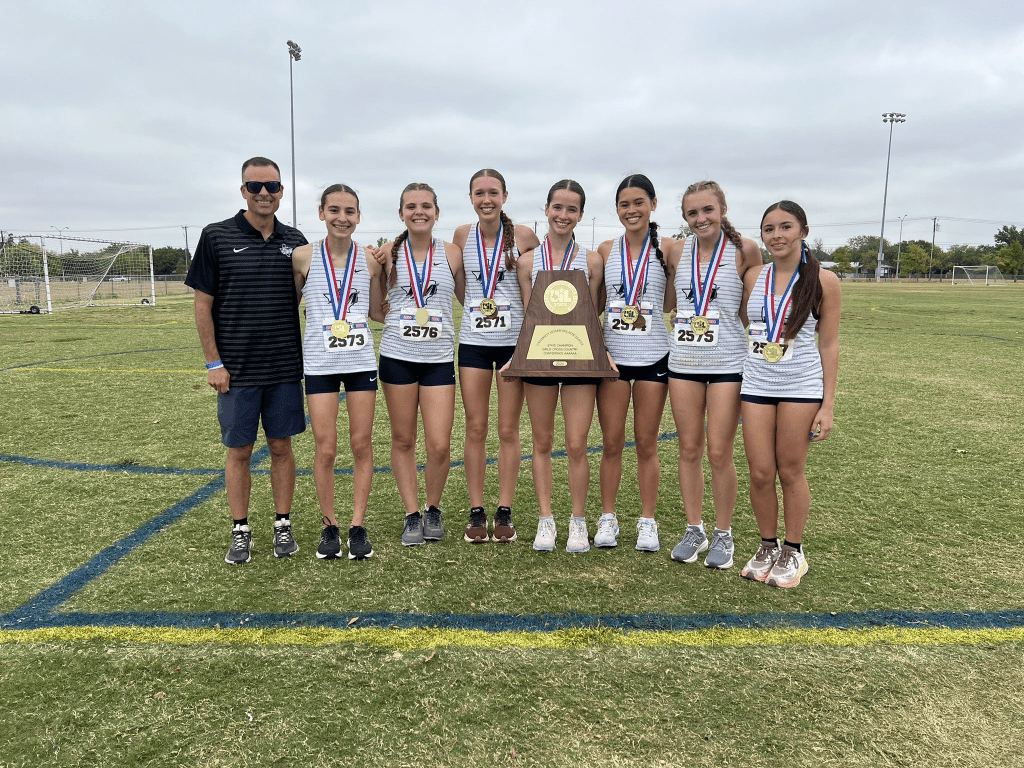
I don’t usually write specifically about our team, but I’m incredibly proud of our girls for winning their fifth consecutive state championship. With so many great teams and coaches in Texas, reaching the top of the podium is a huge achievement. I’m also proud of our boys for returning to state and placing eighth. Our boys didn’t have a standout individual, yet they worked hard as a cohesive team all season to achieve their goals.
Some Things We Did as a Team to Reach Our Goals
Taking a Break This Summer – For the first time in my coaching career, I took about three weeks off from coaching this summer. This break helped me feel fresher and more energized when we started serious training in August. By the end of last cross country season, I was mentally and physically burned out. While this wasn’t the athletes’ fault, I realized I wasn’t taking care of myself.
Keeping Things Simple – Our workouts primarily consisted of threshold repetitions, 200-meter hill repeats, and some form of fartleks. We rotated through these three for most of the season. This approach made it easier to monitor athletes’ progress and maintain consistency.
Focusing on the Team – We emphasized the importance of working hard together and pushing each other to improve.
Character Counts – We had great leaders on our team who understood our program’s expectations and led by example.
Track Matters – A strong track season often leads to a strong cross country season. Last year, we graduated two of Texas’s best distance runners on the girls’ side. This year, we could have settled for less, but our JV girls worked hard during track season and improved dramatically. Their progress on the track gave them the confidence to compete for another state championship.
Cross Country season is over and it’s now time to prepare for the upcoming track and field season. After taking a complete break from running we slowly build the duration and intensity of our workouts. Athletes begin to get excited about competing again and running personal records on the track. I feel goal setting is very important in keeping our athletes focused and motivated for the duration of the track and field season.
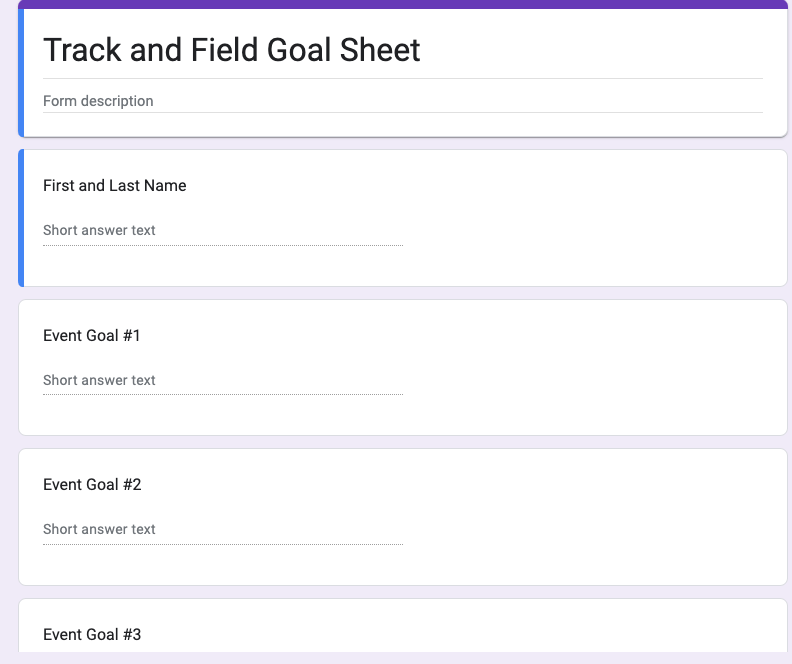
I send out a google form to our team and ask them to fill out three type of goals
1: Individual Goals– Individual goals are focused on times they want to run that season. Individual goals also include things like wanting to run on varsity or place top three in one event at district.
Feedback I give for individual goals are whether they are achievable for that season. If a goal seems a little out of reach I will ask them to include a short term goal as well just in case they don’t reach that ultimate goal. For example if a 5:10 miler wants to run 4:40 and 10:00 I may encourage them focus on breaking 5 minutes in the mile first.
2. Process Goals– What are they going to do in order to reach their goals for the season? Often times they list something training related like run 10 percent more miles each week, but most of the time kids list something like getting 8 hours of sleep or eating more fruits and vegetable at each meal.
Feedback I give for individual goals is to make sure they are measurable. Don’t just put down get more sleep or drink more water. I’ll also give them some constructive criticism like focus on being more consistent in your training and run 6 days a week. I’ll also focus on the little things like make sure you show up to practice on time and complete all strength training exercises.
3. Team Goals- Track can be a very individual based sport. I want our athletes focused on how they can not only make themselves better but their teammates as well. If we have a great chance to win district for example I want our entire team focused on that goal.
Feedback I give for team goals is to let them know that I’m excited about the team as well. The team is an important aspect in track and field I want them to know what they can do to help us have a successful season. When we focus on the team I hope we will get less students asking to sign out before the conclusion of the meet or kids more willing to step up and run that 4×400 Relay.
Here is the link (click the picture) to the goal sheet form we used this year for our track and field team. Feel free to make a copy, edit and use for your team.
And one last story to share on why goal setting is important to me: During my time as a student athlete at Texas A&M, I had the privilege of listening to a speech by Billy Mills. Billy Mills is known for being the 1964 Olympic Gold Medalist in the 10K (my event in college!). His victory is still considered one of the biggest upsets ever. One thing I will always remember is his personal story on goal setting for the 1964 Olympics. He asked the crowd to raise their hands if they set goals and of course with a room full of collegiate athletes, we all raised our hands. Then he asked who had their goals in a place they could see them every day; half of the room continued to keep their hands raised. Lastly, he asked who had their goals on them that night; all of the athletes lowered their hands. He then pulled his wallet from his pocket, opened it, and showed the room an old folded piece of paper. On that paper he told us was his goal for the 1964 Olympics, which was to win the gold medal.



 Texas Running Coach